How to Plan a Wedding Where the Main Course Is a Pastry Tower and Nobody Misses Dinner
We found ourselves standing in a reception hall in Portland one Saturday in late August, watching a tower of cream puffs slowly settle under its own weight. The bottom tier had begun to lean about forty-five minutes into cocktail hour, and by the time the couple cut into the top one — a single, oversized profiterole filled with vanilla bean custard — the whole structure had developed a noticeable list. Nobody cared. The guests had already eaten their way through three hundred miniature fruit tarts, two hundred chocolate éclairs, and a dozen trays of something the caterer called “cheese clouds” that turned out to be gougères so light they dissolved on the tongue before you could identify the cheese inside.
The bride had told us earlier that she and her husband had made exactly two decisions about their wedding from the beginning: they wanted it to feel like a party, not a production, and they did not want to sit through a plated meal. The first decision led to the second. Once you remove the seated dinner from a wedding timeline, something shifts in the energy of the room. People move. They circulate. They stand around a dessert table in clusters that reform every few minutes instead of being locked into a table assignment for an hour and a half. The couple had extended cocktail hour to two hours, then rolled straight into dancing. The pastries were scattered across three stations on the perimeter of the room, and the only announced moment was the cream puff cutting. Everything else was self-serve, self-timed, self-directed.
This is not as radical an idea as it sounds. Dessert-only receptions have become more common over the last several years, especially among couples who find the traditional three-course wedding meal either prohibitively expensive, logistically complicated, or simply wrong for the kind of event they want to host. But the logistics require more thought than simply replacing a steak dinner with a cupcake tower and calling it done. The couple in Portland had spent months working out the details — pastry counts, timing, dietary coverage, structural engineering of the tower itself — and even then, there was that lean.
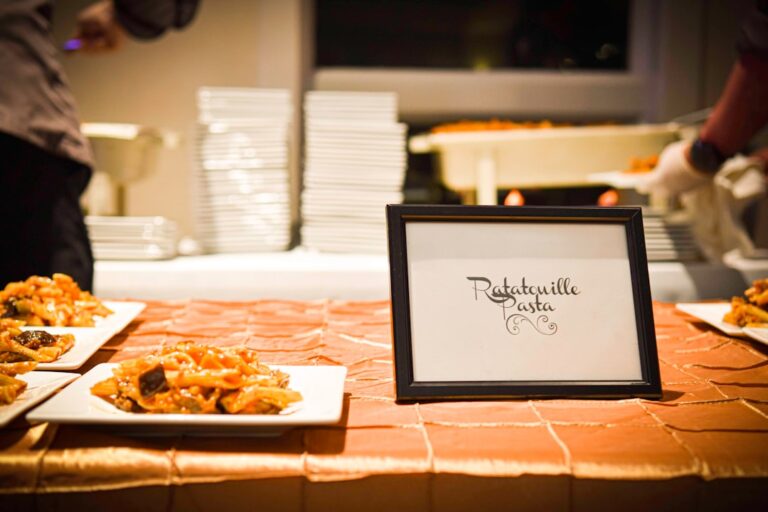
**Pastry counts need to be calculated differently than dinner portions.** A standard wedding dinner assumes roughly one pound of food per adult guest over the course of the meal, distributed across appetizer, main, and dessert. Dessert-only does not mean replacing that pound with a pound of sugar. What worked in Portland, and at two other dessert-only receptions we’ve attended since, is six to eight pieces per person spread across at least four different categories. Not all of those pieces are sweet. The couple in Portland allocated somewhere around a third of their total pastry budget to savory options — gougères, mini quiches, mushroom vol-au-vents — and another third to items that straddled sweet and savory, like fig-and-prosciutto palmiers and a tiny goat-cheese tart with honey. Only the remaining third was purely dessert. No one felt like they had eaten a bag of candy for dinner, and the sweet items became highlights rather than the only option.
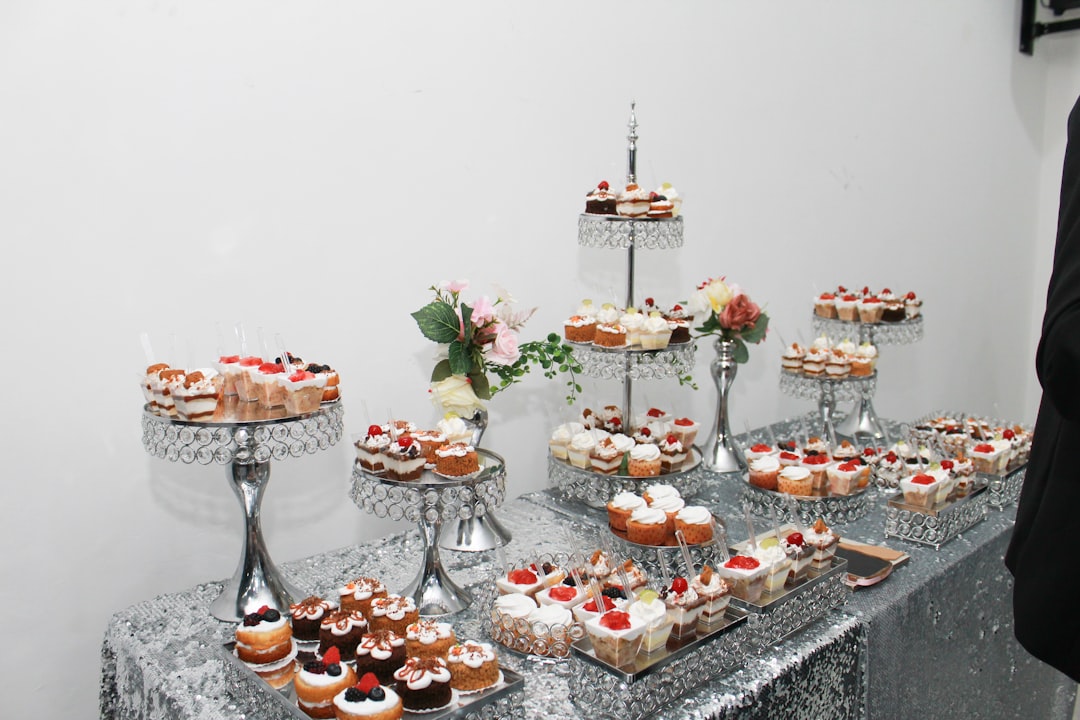
**The tower is a centerpiece, not a meal.** We have seen couples put tremendous pressure on a single towering structure to carry the entire visual and culinary weight of the reception. The Portland couple’s leaning cream puff tower taught us something useful: a tower works best when it is treated as a symbolic centerpiece that gets cut and distributed, while the actual volume of food comes from separate stations or passed trays. The tower does not need to feed everyone. At a wedding in Los Angeles last spring, the couple had a four-tier macaron tower that served maybe thirty people, while the remaining hundred and fifty guests ate from a buffet of warm madeleines, crème brûlée in tiny ceramic pots, and a churro cart that someone had rented from a local caterer. The macaron tower was the photo moment. The churro cart was where people actually ate dinner.
**Timing matters differently when there is no main course.** Traditional wedding dinners impose a rhythm: cocktail hour, first course, main course, toasts, dessert, dancing. Remove the main course and the risk is that the whole event feels like one long cocktail hour with sugar. The Portland couple solved this by structuring their dessert service in waves. The first wave, during what would have been cocktail hour, was entirely savory and light — the gougères, some skewered shrimp with a dipping sauce, a small cup of chilled cucumber soup. The second wave, about forty minutes later, introduced the sweet-savory hybrids and the first round of pastry trays. The third wave, after the tower cutting, was pure dessert. Each wave lasted about twenty-five to thirty minutes, and the gaps between waves gave guests time to wander, talk, dance, or simply sit without a plate in front of them. The reception felt leisurely rather than rushed, and nobody complained about being hungry because the food kept arriving in intervals that matched the natural flow of conversation.
**Dietary restrictions become both easier and harder.** Easier because you are not tasked with producing a single main course that accommodates everyone. Harder because when every item is individually portioned, you need more variety to cover the same range of restrictions. The Portland couple made sure that at least forty percent of their total pastry count was either gluten-free, dairy-free, or vegan, and they labeled every item clearly on small cards placed next to each tray. This required working with a pastry chef who understood that a gluten-free pastry needs to be as good as the gluten version, not a compromise. The chef they hired had spent a year at a gluten-free bakery in Seattle before opening her own shop, and she told us that the key was treating the restrictions as parameters rather than limitations — she made a buckwheat-and-cocoa financier that several guests preferred to the wheat-flour version, and a coconut-milk panna cotta that disappeared faster than the dairy-based one. If you are going to do dessert-only, find a pastry chef who genuinely wants to solve the restriction problem rather than treating it as an obligation.
**Drinks need to be reconsidered.** A dessert-heavy menu changes how wine and cocktails taste. The couple in Portland served a sparkling rosé throughout the reception, which worked well with the savory and hybrid items but clashed with the sweeter desserts. They had not anticipated this, and by the third wave, many guests had switched to coffee or tea that the caterer had set up on a separate table. At the Los Angeles wedding, the couple had a better solution: they offered a single signature cocktail made with mezcal, lime, and a chamoy rim that was tart and slightly spicy, plus a dry sparkling wine, and they kept a coffee bar running from the start of the reception through the end. The acidity and bitterness of the coffee and the cocktail provided the contrast that the sweet pastries needed, and the sparkling wine worked across the savory-sweet spectrum. Dessert-only does not mean sweets-only drinks, and the beverage program deserves as much thought as the pastry program.
**The weather factor is real.** The Portland reception was indoors, but a dessert-only reception that relies on delicate pastries — cream puffs, éclairs, mousse-based items — does not travel well into heat. We attended a backyard wedding in Oakland in July where the couple had planned a dessert-only reception with an outdoor station of chocolate-dipped strawberries and small custard tarts. By the second hour, the strawberries had started to weep and the custard tarts had turned soft in the sun. The caterer improvised by moving the remaining pastries into a shaded breezeway and bringing out a backup supply of cookies and brownies that held up better in the warmth. The lesson is not to avoid outdoor dessert receptions, but to plan for the temperature. Items that are shelf-stable at room temperature — cookies, brownies, financiers, biscotti, macarons — hold up better than anything with a custard, cream, or fresh fruit filling. If you must have cream-based items, keep them in a refrigerated setup until the moment they are served, and serve them in small batches rather than leaving them out on a table.
**The guest experience changes in ways that are worth planning for.** At a traditional dinner, guests know exactly what to expect: they sit, they eat, they wait for the next course. At a dessert-only reception, there is no waiting, but there is also no structure, and some guests find that disorienting. The Portland couple addressed this by printing a simple timeline on the back of their program: “Savory bites from 5:00 to 6:00. Pastry parade from 6:00 to 7:00. Tower cutting at 7:15. Dancing until late.” The timeline gave guests a sense of progression even without a seated meal. The Los Angeles couple took a different approach: they announced each wave from the DJ’s microphone, not as a formal instruction but as a casual “the madeleines are fresh out of the oven, head to the back table if you want one while they’re warm.” That small act of announcing kept the reception from feeling like a free-for-all and gave guests a reason to pay attention to the timing.
**The cost comparison is not as simple as it looks.** Dessert-only receptions can be cheaper than full dinners, but not always. The Portland couple spent roughly forty percent less on food than they would have for a plated dinner, but they spent more on rentals — they needed more tables and serving pieces to accommodate multiple stations, and they needed a separate table for the coffee bar. The pastry chef cost more per item than a standard wedding caterer would have charged for a plated dessert, because the labor involved in producing three hundred individual tarts is higher than baking a single cake. The savings came from eliminating the hot-food kitchen setup, the serving staff for a plated meal, and the rental of dinnerware and glassware for a full table service. The couple used compostable bamboo plates and cups for the buffet stations, which cut their rental bill significantly. A dessert-only reception that tries to replicate the formality of a plated dinner — with china, silverware, and full table settings — will not save as much, and the savings are better spent on higher-quality pastry or a more interesting beverage program.
**The tower design matters less for food and more for theater.** We have seen towers made of doughnuts, towers made of macarons, towers made of mini cheesecakes, and the leaning cream puff tower in Portland. The one that worked best, from a structural and visual standpoint, was at a wedding in Brooklyn where the couple had commissioned a three-tier tower of chocolate-dipped madeleines arranged on a custom steel frame. The madeleines were not stacked on top of each other — they were individually suspended on small hooks, like ornaments, so that guests could pluck them off without destabilizing the structure. That tower did not lean, did not collapse, and made it through the entire reception without a single guest having to wrestle a cream puff free from a sticky neighbor. If a tower is part of the plan, consider asking a pastry chef or a designer who works with food installations how to build it for access rather than just for looks. A tower that requires a surgical extraction to remove a single piece is a tower that will create a logistical headache at exactly the moment everyone is watching.
The reception in Portland ended around eleven, with the tower still standing — leaning, but standing — and a handful of guests lingering around the remaining pastry trays. The bride and groom had disappeared onto the dance floor about forty-five minutes earlier and had not come back. The caterer began packing up the remaining items, and someone asked if the leftovers would be boxed up for the couple. The answer was no — the couple had already taken a box of the cheese clouds and a few fig palmiers back to their hotel room, and everything else was offered to the guests as they left. We took a small bag of buckwheat financiers on the way out, ate them cold on the sidewalk while waiting for a ride. They were still good.
Whether a dessert-only reception works for a given couple depends on what kind of event they want to host. It is not a shortcut to a cheaper wedding, though it can be. It is not a way to avoid thinking about food, because the food becomes the entire focus. It is a way to change the shape of the evening — to trade the rigidity of a seated dinner for the looseness of a party where the food moves with the guests instead of the other way around. Some couples will find that looseness freeing. Others will miss the anchor of a shared meal. But the option exists, and the details of how to pull it off are worth knowing before the first pastry order gets placed.

📷 Photos: Fotógrafo Samuel Cruz (Unsplash), Fotógrafo Samuel Cruz (Unsplash)