How to Replace a Traditional Church Wedding with a Bothy Elopement
How to Replace a Traditional Church Wedding with a Bothy Elopement
On a Tuesday afternoon in early November, a couple in their late twenties stood outside a stone building in the Cairngorms National Park, watching rain run off the roof in sheets. Inside, there were no chairs, no altar, no sound system. There was a wood-burning stove that hadn’t been lit yet, a single shelf with a kettle and two mismatched mugs, and a damp chill that felt about forty years old. This was where they were getting married in two hours.
The idea had started six months earlier, after a conversation about guest lists. The couple had around 120 close friends and family between them, and every venue they priced came back at roughly the same figure: £180 to £250 per head for a standard Saturday evening, which meant the reception alone would cost somewhere north of £20,000 before they added a photographer, a band, a dress that wouldn’t look out of place, and whatever a florist charges for arrangements that wilt by midnight. Neither of them had that kind of money saved, and neither wanted to borrow it.
One of them had seen a photo of a bothy — a basic stone shelter maintained by the Mountain Bothies Association for walkers and climbers — and the thought took hold. No electricity. No running water. No catering. No backup plan if it poured. But also: no per-head minimum, no corkage fee, no dance floor rental. The bothy cost nothing to book, though a donation of £10 per person was standard practice. The entire wedding, from the registrar’s fee to the celebrant to the caterer they hired for a single hot meal, came to roughly £4,200.
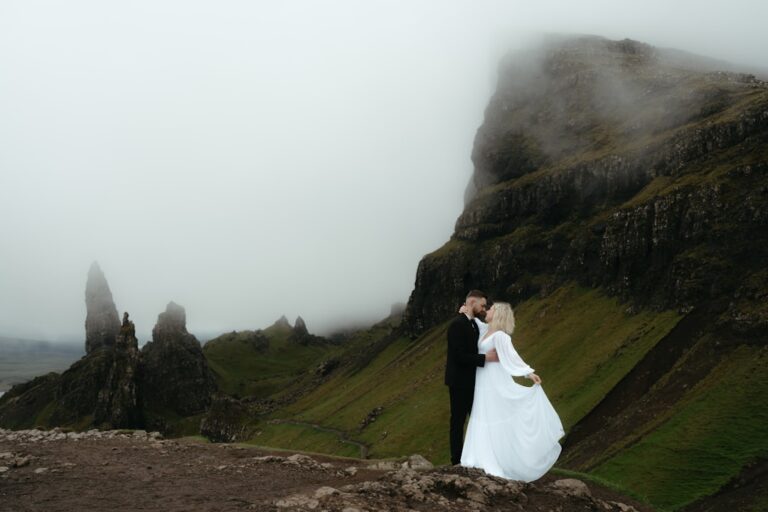
The reception that replaced the church hall was a two-hour walk through heather and bog, a meal eaten off camping plates, and a night spent in sleeping bags on foam mats by a fire that one guest kept calling “the best radiator in Scotland.” It was, by any conventional wedding metric, deeply impractical. And it is, for a growing number of couples, exactly the kind of wedding they want.
Do You Actually Want to Sleep in a Bothy?
The romance of the idea tends to outpace the reality for about half the couples who consider it, according to Renata, a celebrant based in Inverness who has officiated at roughly two dozen bothy weddings over the last five years.
“Most people imagine a cozy stone cottage with a fireplace and fairy lights,” she says. “What they get is a single room with a dirt floor, a composting toilet fifty yards away, and the knowledge that if they forget matches, there’s no backup.” The bothies maintained by the MBA are deliberately basic — no mattresses, no furniture beyond maybe a bench or a shelf, nothing that would encourage permanent habitation. They are shelters for people caught in bad weather, not glamping cabins.
What makes a bothy work for a wedding is the same thing that makes a bothy work for a hiker: it forces everyone to arrive at the same place with the same minimum expectation, and it strips away every distraction. There is nowhere to check a phone. There is no bar to stand at. There is no separate room for children to run around in while adults talk. Everyone is in the same space, sitting on the same floor, drinking the same instant coffee from the same kettle.
The couple who made that November trip — let’s call them Anna and Callum, because that’s close enough to their real names — had exactly that experience. “We invited eighteen people,” Anna says, “and we told them all the same thing: bring a sleeping bag, bring warm clothes, bring whatever you want to drink, and be ready to walk two miles uphill.” Of the eighteen, fourteen came. The four who declined did so because of mobility issues, and the couple made peace with that early on. A bothy wedding is, by definition, a wedding that selects for its own guest list.
A Bothy You Can’t Book
The Mountain Bothies Association maintains roughly one hundred bothies across Scotland, northern England, and Wales. Not all of them are suitable for a wedding. Some are too small to hold more than four people. Some are in locations that require a full day’s hike. Some are actively in use by other walkers on any given night, because bothies operate on a first-come, first-served basis with no reservations.
This is the critical constraint: you cannot book a bothy. You can arrive and hope it’s empty, or you can coordinate with other users through informal channels — a forum post, a message to a local walking club, a note left in the bothy logbook weeks in advance — but there is no guarantee. The couple who made the November trip checked the bothy three weeks ahead by driving to the nearest parking area and walking in to look. It was empty. They left a note on the shelf asking anyone planning to use it on their date to please consider another bothy a mile and a half away, and they checked again a week before. It was still empty.
For the wedding itself, they targeted a bothy that slept ten comfortably, with room for another six on the floor if people squeezed. The bothy had a fireplace, a shelf, and a single window that faced east. The door didn’t lock, because bothies don’t have locks. They brought a tarp to hang over the doorway as a windbreak, and they asked a friend who owned a van to drive up the firewood a day early.
When choosing a bothy, the practical checklist looks like this:
- Capacity: Can it physically fit your group? Assume floor space only, not bunks.
- Access: How far is the walk from the nearest road? Anything over two miles means your guests are carrying everything themselves.
- Water: Is there a burn (stream) nearby? You’ll need it for washing and drinking, and you’ll need to boil it or bring tablets.
- Fire: Does the bothy have a fireplace or stove? If not, you’re relying entirely on body heat and layers.
- Privacy: How likely are other walkers to show up? A bothy on a popular long-distance route is a different proposition than one tucked into a remote glen.
Paperwork First, Ceremony Second
A bothy cannot host a legal marriage ceremony in Scotland unless a registrar is present, and registrars generally do not hike two miles into the hills. The couple dealt with this by having a small legal ceremony at the local registry office in Aviemore three days before the bothy weekend. The registry office ceremony cost £85 for a standard weekday appointment, plus £11 for the marriage certificate. It took seven minutes and involved two witnesses who were also coming to the bothy.
The bothy gathering itself was a symbolic ceremony led by a humanist celebrant — a legal option in Scotland since 2005, provided the celebrant is registered with the relevant body. Renata, the celebrant, charges £350 for a ceremony that includes a script tailored to the couple, a walkthrough beforehand, and the ceremony itself. She also brought a portable speaker that ran on batteries, because bothies have no electricity.
The practical trade-off is worth understanding. A registry office ceremony is bureaucratic and unromantic. But it solves the legal problem cleanly, and it means the bothy event is free to be whatever the couple wants — no pressure to fit the wording of the law into a muddy hillside. Some couples do the registry office months in advance and treat the bothy as a vow renewal. Others do it the same week and treat the bothy as the real wedding, with the paperwork as an administrative errand.
Felix’s Stew, and Other Meals with No Kitchen
This is the part that stops most couples cold, and it’s the part where a bothy wedding either works or doesn’t. The couple in question hired a caterer from Aviemore who specialized in outdoor events. The caterer’s name was Felix, and he arrived two hours before the ceremony with a portable gas stove, a large pot, and three coolers. He served a single course: a lamb and root vegetable stew that had been cooked the day before and reheated on the stove. With it came crusty bread, butter, and a simple salad. Dessert was a tray of tablet — a Scottish confection made of sugar, condensed milk, and butter — that Anna’s mother had made at home and carried up in her rucksack.
Felix charged £28 per person for the meal, which included the stew, bread, salad, and hot drinks. He brought his own plates and cutlery, all metal campware that he washed in the burn afterward. The total for fourteen guests was £392, plus a £50 tip.
The alternatives are limited. A bothy has no oven, no running water, no refrigeration, and no counter space. Anything hot has to be cooked on a camping stove or brought in pre-cooked and reheated. Anything cold has to stay cold in coolers carried in by hand. The most common approach among bothy wedding couples is a one-pot meal — stew, chili, curry, soup — supplemented by bread, cheese, cured meats, and whatever fruit survives being jostled in a backpack for two miles.
One couple Renata worked with brought a whole salmon, poached the day before and wrapped in foil, and served it with new potatoes and a dill sauce. “It was ambitious,” Renata says, “and it worked because they had eight people carrying one item each.” That division of labor is the key insight: nobody carries everything, but everyone carries something.
What Fourteen Guests Signed Up For
The guest experience at a bothy wedding is not the guest experience at a traditional wedding, and mismatched expectations are the most common source of friction. The couple sent out what Anna called “the reality email” three weeks before the date, with a bullet-point list of what to expect:
- There is no car access. You will walk approximately two miles over uneven ground.
- You will need a sleeping bag rated to at least -5°C. Renting one costs £15–20 from an outdoor gear shop in Aviemore.
- Bring a head torch. It gets dark by 4:30 PM in November, and the bothy has no lights.
- Bring your own cup, bowl, and cutlery. Nothing disposable — you’re carrying everything out again.
- There is no toilet indoors. There is a composting toilet fifty meters from the bothy, and the local rule is “if you pack it in, pack it out.”
- Alcohol is welcome, but glass bottles are heavy and breakable. Decant spirits into plastic flasks. Canned beer is ideal.
Of the fourteen guests who came, one forgot their sleeping bag and spent the night in a bivi bag borrowed from another guest. One brought a small tent and slept outside, which the couple had explicitly discouraged but which the guest preferred. Everyone else slept on the bothy floor on foam mats that one of the guests had brought in bulk from a decathlon in Inverness — £8 each, for a total of £96 for twelve mats.
The Ceremony Itself
Renata arrived an hour before the ceremony to set up. She placed a small table near the window — actually a wooden crate turned on its side — and covered it with a piece of tartan fabric Anna had brought. On top went a vase with a single stem of heather, a candle in a glass jar, and the couple’s handwritten vows. The guests sat on their sleeping mats in a semicircle. The ceremony lasted twenty-two minutes, including the reading of a poem by one guest and the exchange of rings.
The thing that surprised the couple most, Anna said later, was how quiet it was. No traffic noise. No distant music from another event. No announcements over a microphone. The only sounds were the fire, the rain on the roof, and fourteen people breathing in a small stone room. “You could hear everyone sniffling during the vows,” she said. “It felt like we were all in it together in a way that a church never would have managed.”
The practical point is that a bothy ceremony works best when it’s short and simple. The room has no acoustics designed for speeches. There is no amplification. The fire needs to be kept going, which means someone has to get up and add wood at regular intervals. The couple designated one guest as fire-keeper for the evening, and that person’s role was simply to make sure the stove didn’t go out. It was not a romantic job, but it was essential.
Dripping Walls at Midnight
After the ceremony, Felix served the stew. People ate sitting on the floor, leaning against their rucksacks. A bottle of single malt was passed around. Someone produced a ukulele and played four songs before realizing the strings were too cold to stay in tune. By 8:30 PM, the conversation had slowed, and people started crawling into their sleeping bags. By 9:15, the fire was banked and most people were asleep.
One detail that no one had anticipated: the condensation. With fourteen people breathing in a small stone room heated by a fire, the walls were dripping by midnight. Sleeping bags that touched the walls got damp. The couple learned afterward that a common bothy trick is to hang a tarp from the ceiling to catch condensation, or to sleep with your head away from the wall. They wished they’d known this beforehand.
Morning came early, because the east-facing window let in light by 6:30 AM regardless of anyone’s plans. Felix returned at 8 AM with a pot of porridge, a jar of honey, and a flask of tea. People packed their damp sleeping bags, swept the floor — bothy etiquette requires leaving the shelter cleaner than you found it — and walked back to the cars by 10 AM. The entire event, from arrival to departure, had lasted about eighteen hours.
Months later, Anna and Callum had a small gathering in their living room for the friends who couldn’t make the walk. They showed photos on a laptop. They served the same stew recipe, adapted for a kitchen stove. Nobody danced. Nobody did a first dance or cut a cake or threw confetti. But a few of the guests who had been at the bothy told them, weeks afterward, that it was the only wedding they’d ever been to where they genuinely felt like they’d shared something real with everyone in the room.
That’s the trade-off a bothy wedding makes. It trades comfort, convenience, and predictability for a single thing: the sense that everyone present has chosen to be there, and that the occasion itself demanded something more than showing up in a suit and sitting in a pew. Whether that trade is worth making depends entirely on what a couple wants their wedding to feel like — and, more practically, on whether they can find fourteen people willing to carry a sleeping bag two miles uphill in November rain.
📷 Photos: Annie Spratt (Unsplash), James Eades (Unsplash)