
My grandmother’s ragù recipe nearly derailed my wedding week
My grandmother’s ragù recipe nearly derailed my wedding week
I had this whole plan. It felt like the kind of thing that would make the wedding truly ours — instead of hiring some caterer who’d serve us the same truffle risotto every other couple gets in a Tuscan villa, we’d bring my Nonna’s recipes. The ones she’d written on index cards in her slanting cursive, the ones I’d watched her make for thirty years. The ones that tasted like Sunday afternoons and arguments about who burned the garlic.
The rehearsal dinner would be her food. In Tuscany. Cooked by a Tuscan chef.
That sentence sounds romantic until you’ve actually tried to make it happen.
Podere il Casale and the problem with “interpret”
I found the villa first — a 16th-century farmhouse near Montepulciano called Podere il Casale, booked through a site I’d found on a wedding forum. The owner, a woman named Elena, spoke perfect English and assured me they had a fully equipped professional kitchen. “You can bring your own chef,” she said on our first video call. “Many couples do. I have a list of recommended caterers.”
The problem was I didn’t want a caterer. I wanted someone who would look at my grandmother’s handwritten recipe for braciole — the one that says “add more wine if it looks tight” — and just know what that meant.
I asked around. The villa’s list had three names, all of whom I emailed. Two never responded. The third, a woman named Chiara, replied with a PDF of her standard menu: €120 per person for a five-course tasting menu, minimum twenty guests. I wrote back explaining the concept — family recipes, my grandmother’s method, the specific cut of beef she used — and got a polite email saying she’d be happy to “interpret” them. The word hovered in my inbox like a threat.
I should have stopped there. I should have realized that “interpret” meant “make the food you want but fancier and more expensive and nothing like what your grandmother actually made.” But I was three months out from the wedding and the idea of telling my mom we were doing a standard catered dinner felt impossible.
Through a different forum — Reddit, actually, the wedding planning subreddit — someone mentioned a chef in Florence who took commissions. His name was Marco. His Instagram showed the kind of food you expect: bright tomatoes, hand-rolled pasta, dishes arranged on slate tiles. I messaged him, explained the whole thing, and he replied within an hour. “This sounds beautiful,” he wrote. “I love cooking food that means something to people.”
He quoted me €1,800 for the full rehearsal dinner — twenty-two people, five courses, including a tasting session one week before. That felt reasonable. I sent a deposit, €600, via PayPal. He sent back a confirmation with his address in Florence.
I told myself this was fine. He’s a chef, he said he loves the idea, he’ll figure out Nonna’s weird shorthand for “a handful of parsley.” What could go wrong?
Rain outside a kitchen supply store
Three days before the wedding, my fiancée Sarah and I drove from the villa into Florence for the tasting. It was late April and raining — not the gentle Tuscan spring rain you imagine, but the kind that comes sideways and makes the cobblestones slick. We parked near the Duomo and walked ten minutes to the address Marco had given us. It was a kitchen supply store.
Not a restaurant. Not even someone’s apartment kitchen. A store that sold industrial mixers and pots.
I stood in the doorway while a woman behind the counter looked at me like I was lost. “Marco?” she said when I asked. She shook her head. “He used to rent the prep space in the back. He’s not here anymore. It’s been maybe six months.”
My phone had no service. I tried to call the number I’d been using — it rang and rang. We stood in the rain for a while, sharing the awning with a man selling roasted chestnuts, and I thought about the €600 I’d sent to an Instagram account.
I cried for exactly four minutes in a cafe called Caffè della Piazza, and then I remembered that Elena, the villa owner, had given us her personal number. Not for emergencies — just “in case you get lost or need a restaurant recommendation.” I called her.
She picked up on the second ring. I explained the situation, trying not to sound as panicked as I felt. There was a pause, and then she laughed. Not a mean laugh — the kind of laugh someone does when they’ve seen this exact disaster before.
“Give me two hours,” she said.
She called back in ninety minutes. Her cousin’s neighbor — a retired chef named Umberto who had run a trattoria in Siena for forty years — was available. He didn’t speak English. He didn’t have an Instagram. He’d cook anything I wanted, for €500 for the evening, plus the cost of ingredients. He wanted to meet me the next morning at the market in Montepulciano.
Umberto writes on the recipe card
Umberto was maybe seventy, with hands that looked like they’d been shaped by decades of knife work. He met me at the market entrance at 8 a.m., shook my hand once, then said something to Elena’s cousin’s daughter, a woman named Giorgia who’d agreed to translate. What he said, through Giorgia: “Show me the recipes.”
I pulled out the folder I’d brought from home — the same folder I’d been carrying through Tuscany, the one with Nonna’s index cards and a few photocopies my aunt had made. Umberto took it without asking. He flipped through the cards slowly. When he got to the braciole recipe — the one with the wine instruction — he stopped.
He said something to Giorgia.
“He wants to know,” she said, “if your grandmother used pork or beef for this.”
I told her beef. Specifically, top round, pounded thin.
Another exchange. Giorgia said, “He asked if she cooked it on the stove or in the oven. He says the oven is wrong for this cut.”
I didn’t know the answer. I’d never asked. I’d watched her make it a hundred times and I couldn’t remember if she transferred the pot to the oven or left it on the burner. I told Umberto I wasn’t sure.
He nodded, said something else, and wrote a note in pencil on the edge of the card. Giorgia translated: “Stove, low, three hours minimum. The oven dries it out.”
I had been planning to tell a chef how to cook my grandmother’s food. Umberto was about to teach me how she actually did it.
We spent an hour at the market. Umberto bought the meat from a specific butcher — not the one closest to the entrance, but a stall in the back with a handwritten sign and a customer line three deep. He bought tomatoes from a woman who seemed to know him, and they argued in rapid Italian over which variety to use. He bought pecorino from another stall and made a face, then bought a smaller wedge from a different vendor and looked satisfied.
I paid for everything — €87 total for ingredients for twenty-two people. He carried the bags like they weighed nothing, which they did not.
That afternoon, I texted Sarah: “I think it’s going to be okay.” She texted back: “What about the tasting?” I hadn’t even asked. I just trusted him.
The braciole on the stove
The rehearsal dinner was scheduled for the evening before the wedding, in the villa’s courtyard. The forecast had cleared — cool, clear, the kind of evening where you need a jacket but don’t mind because the stars are out. Umberto arrived at 3 p.m. with a small cooler and a bag of his own knives. He didn’t want help. He wanted someone to show him where the stove was, and then he wanted to be left alone.
At 6, guests started arriving. My mom walked into the kitchen to say hello and came out twenty minutes later holding a spoon. “He let me taste the ragù,” she said. “It’s the same. It’s exactly the same.”
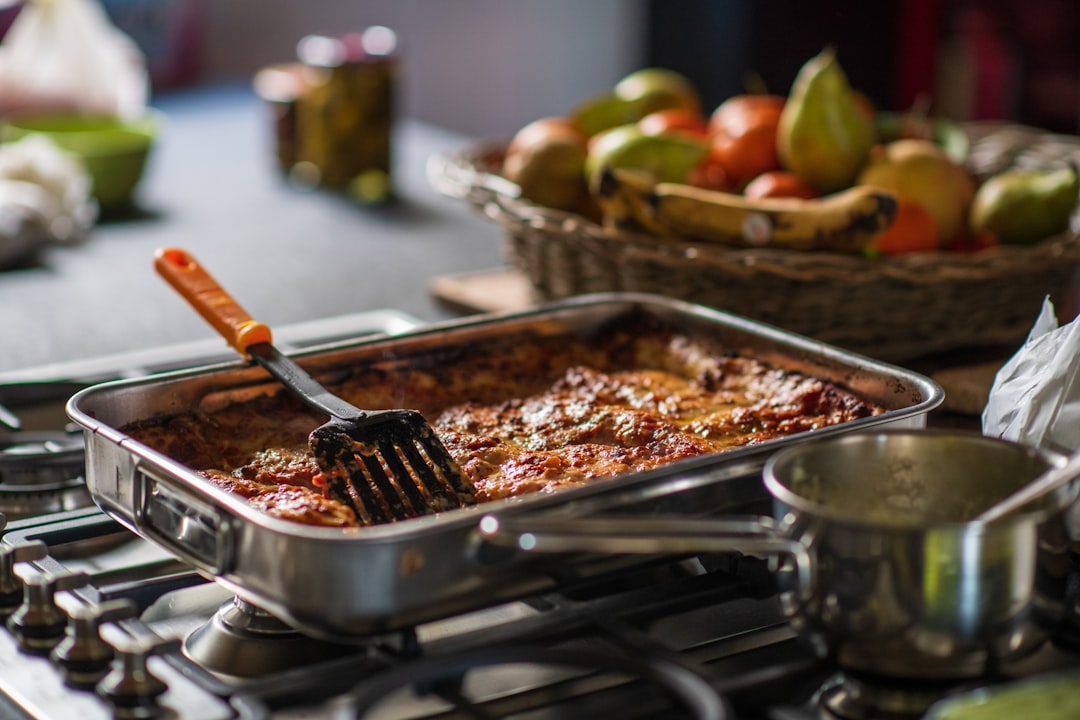
I didn’t believe her until dinner was served. The first course was the antipasti — prosciutto and melon, pecorino with honey, the familiar shape of Nonna’s crostini. Then the pasta was hand-rolled pici with the ragù, the sauce clinging exactly the way it does at home, the way I’d assumed you needed a grandmother to achieve. Then the braciole, which he’d done on the stove, low and slow, and it was better than I remembered.
At the end of the meal, I found him in the kitchen, washing his own knives at the sink. I tried to thank him in my broken Italian — “Grazie, è stato perfetto” — and he waved a hand. He said something I didn’t catch. Giorgia, who was still there, laughed and translated: “He says your grandmother knew what she was doing. He just followed her instructions.”
I paid him €550 — the agreed €500 plus a €50 tip I’d put in an envelope. He didn’t count it. He shook my hand, said something that Giorgia didn’t translate, and drove away in a small Fiat that had a dent in the passenger door.
The villa had a small notebook in the kitchen for guests to leave notes. Before we checked out, I wrote down the braciole method as Umberto had described it — stove, low, three hours — and added it to the folder with the original recipe cards. I don’t know if anyone will ever use it. But it felt like closing a loop I hadn’t realized was open.
📷 Photos: Jochen van Wylick (Unsplash), Mark Boss (Unsplash)