She wore a cropped veil with a jumpsuit. I needed to understand how.
She wore a cropped veil with a jumpsuit. I needed to understand how.
The woman ordering coffee next to me at the Brooklyn Roasting Company in FiDi was wearing what I can only describe as a wedding outfit that had clearly finished its job for the day — and looked better for having done so. It was a Thursday afternoon in November, and she was still in her ceremony clothes: a cream-colored crepe jumpsuit, wide-legged, with a low V back, and perched on her head, angled slightly to the left, was a short, birdcage-style veil that stopped just above her eyebrows. She had on sneakers — Vejas, I think — and there was a smudge of mascara under her right eye. I couldn’t help myself.
“Did you just get married?”
She laughed. “This morning. City Hall. My mom is still crying about the veil-slash-jumpsuit thing.” She gestured at her outfit. “She wanted me to do a dress.”
“And you wanted to do this.” I wasn’t asking.
“I wanted to be able to walk to lunch afterward without tripping over anything. I wanted to fit in my own bathroom mirror.” She took a sip of her latte, which was definitely oat milk. “And honestly, I wanted to look like me.”
I spent the next forty-five minutes sitting two tables away, trying not to stare, and making notes in my phone. By the time she left — she was meeting her new husband at Joe’s Pizza on Carmine Street — I had roughly a dozen questions I needed to answer for myself. How do you make a cropped veil feel intentional with a jumpsuit? How do you not look like you’re playing dress-up? And where, exactly, are you supposed to buy this combination in the first place?
What cropped means and what it doesn’t
Let’s start with the thing I keep seeing wrong. A cropped veil is not just a veil you’ve cut shorter. It has different proportions, different fixings, and a completely different relationship to your face. The ones that work — and I spent a week looking at photos from elopement photographers in San Francisco, New York, and Los Angeles to confirm this — usually end somewhere between the jawline and the collarbone. Anything that falls into the dip of your cleavage starts to read as “dress veil, but abbreviated” rather than something designed for a different silhouette altogether.
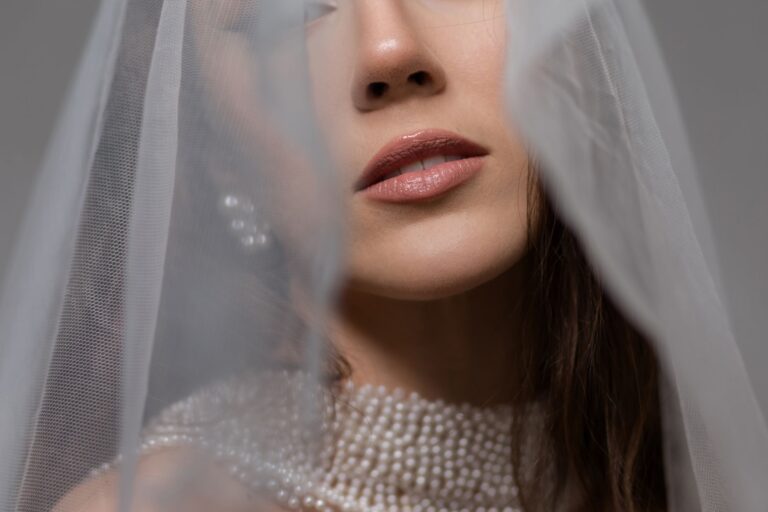
The woman at the coffee shop had one that was comb-mounted, with a single layer of silk tulle. It was gathered at the crown of her head and fell forward slightly, which is the opposite of what a traditional veil does. Normally you want the veil to fall backward, behind the shoulders. With a jumpsuit, that backward fall creates an awkward empty zone between the hair and the neckline — you get a void where the bodice of a dress would normally fill the space. Her veil, by falling forward, framed her face and let the bare back of the jumpsuit do its own work.
I found a similar one later that week at Lovely Bride in the West Village. The salesperson — a woman named Dee who had been doing bridal styling for twelve years and told me she’d “seen every kind of crying” — explained that the trick is to buy a veil that was designed to be short, not a cathedral veil you’ve had hemmed. “The weight is different,” she said. “A full-length veil has heft at the bottom. It falls a certain way. When you cut that off, the rest of the veil doesn’t know what to do. It gets poofy in a bad way.”
The comb matters more than the veil
Dee also told me something I hadn’t considered: the comb itself is visible. With most veils, the comb is hidden by the veil’s own length or by a hairstyle. But a cropped veil, by definition, doesn’t cover much. “You need a comb that looks intentional,” she said. “Either a vintage tortoiseshell comb that you want people to see, or a very narrow metal one that disappears completely. Nothing in between. A clear plastic comb is going to ruin the whole thing.”
I ended up buying a metal comb from her — $18, plus tax — and a short veil in ivory silk tulle for $140. I didn’t have a wedding coming up. I just needed to understand how it all worked physically, the weight of it. I put it on in my apartment that night with a black jumpsuit I already owned (a Gap impulse buy from two years ago that had never felt quite right). The comb held. The veil fell. It made the jumpsuit look deliberate.
The jumpsuit shape changes everything
The woman at the coffee shop was wearing something with a defined waist and a wide leg. I learned later, from a freelance bridal stylist named Tess who I reached out to on Instagram after seeing her portfolio, that this is the safest silhouette for a cropped veil. “The veil is a horizontal accent,” she told me over Zoom. “It cuts across your face. So you need the jumpsuit to give you vertical lines to balance that out.” That means a high neckline — a mock neck, a bateau, a mandarin collar — or a deep V that visually continues downward. A round neckline, she said, “makes you look like a button that popped off a coat.”
I started looking at jumpsuit options more seriously. At Reformation, the Romeo jumpsuit in ivory crepe was $298 and had exactly the kind of clean, structured neckline Tess was describing. At BHLDN, the Wren had a soft cowl neck that felt like a different conversation entirely — less architectural, more fabric-y. But the one I kept coming back to was from a small brand called Misa, founded by a former bridal editor who had gotten tired of the dress-or-pants binary. Their Margo jumpsuit was $525, in a silk-cotton blend, with a high back that came up to the shoulder blades and a front that dipped just enough to hint without showing anything. The model on their site was wearing it with a fingertip-length veil that had raw edges and a single silk flower pinned at the temple. It looked like something you could wear to dinner after the ceremony and have no one know you’d just gotten married until you mentioned it.
The fabric conversation you should have
Tess told me that the biggest mistake people make with jumpsuit-and-veil combinations is a texture clash. “If your jumpsuit is matte crepe, your veil should not be shiny. Full stop. They’re going to sit next to each other in every photo.” She also warned against mixing heavy and light weights. A thick, structured jumpsuit with a whisper-thin veil looks like you forgot the top half of your outfit. A flimsy jersey jumpsuit with a stiff, horsehair-trimmed veil looks like you assembled it from two different eras of your life. The fabric weights need to feel like they belong in the same closet.
I tested this in my own apartment. My black Gap jumpsuit was a cotton-lycra blend — medium weight, matte. The silk tulle veil I bought from Dee was light and soft. Together, they felt fine. But when I tried the same veil with a cheap polyester jumpsuit I’d ordered from Amazon and immediately regretted (the fabric had a sheen that caught light in a sad way), the whole thing looked costumey. The veil looked like it was trying to elevate something that didn’t want to be elevated. I returned the jumpsuit the next day.
Where you wear it changes what you wear
The coffee shop woman told me she’d gotten married at City Hall, then walked to lunch, then taken the subway home. That’s a specific set of constraints. She needed an outfit that could survive a commute, a slice of pizza, and a bathroom selfie without requiring a wardrobe change. A cropped veil and a jumpsuit buys you that. You can sit down, stand up, get on the subway, go to the bathroom without holding anything off the floor.
I found a photographer in San Francisco — a woman named Eva who shoots elopements at City Hall almost every weekday — and she told me that the jumpsuit-plus-cropped-veil look is about 20 percent of her clients now. “It used to be zero, then it was one or two, and now I’d say every fifth couple has at least one person in a jumpsuit.” She said the cropped veil solves a problem most people don’t think about: the wind. City Hall in San Francisco has those massive marble steps and the rotunda doors open directly to the street. “A long veil becomes a liability. I spend the whole ceremony trying to keep it out of people’s faces. The cropped veils stay where they’re supposed to.”
The headband alternative
Eva also mentioned something I hadn’t seen in any styling guide: some people skip the comb altogether and go for a headband-style veil, where the veil is attached to a thin metal or velvet band that sits across the forehead like a crown. “It reads more editorial,” she said. “But it’s also harder to get right. If the band is too tight, it gives you a headache. If it’s too loose, the whole thing slides sideways halfway through the vows.” She said she’s seen it work maybe three times, and each time the person had tried it on at home and worn it around the house for at least two hours before deciding.
I tried a headband veil at a small boutique in Williamsburg called Bindle & Keep — they’re known for custom suiting, but they had a rack of accessories in the back. The headband was velvet, forest green, with a short veil attached. It looked beautiful on the mannequin. On my head, it sat about a quarter-inch too far back and immediately made me feel like I was in a community theater production of a 1920s drama. I took it off and put it back on the rack. The woman working there — I didn’t catch her name — said, “Ninety percent of people put it on and take it off in under a minute. That’s a good test.”
The accessories conversation
The coffee shop woman had no veil on her ears. No visible jewelry at all, actually, except a thin gold chain with a single pearl. I hadn’t noticed it until she turned her head and it caught the fluorescent light of the coffee shop. Tess told me that this is the right instinct. “A cropped veil is already an accessory. You don’t need earrings, a necklace, a bracelet, and a veil. Pick two.”
I bought a pair of small gold hoop earrings from a vintage store on Orchard Street for $12 the week after my research project started. They were cheap and slightly misshapen, and I wore them with my black jumpsuit and the cropped veil one afternoon just to see how it felt. The answer: fine. The hoops were too round, too present. They competed with the veil’s horizontal line. I took them off and the whole outfit settled. Tess’s rule — pick two — meant, in this case, picking the veil and the necklace, and letting the ears be quiet.
Shoes you’ll actually walk in
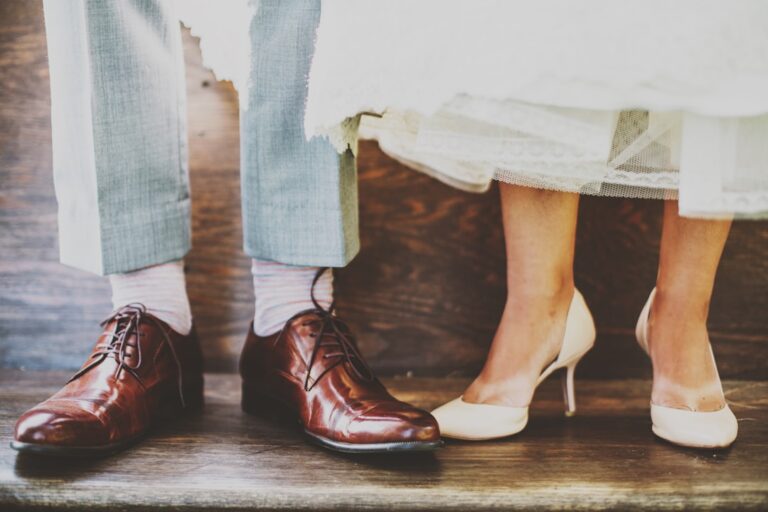
The coffee shop woman’s Vejas were not a compromise. They were the choice. I asked Tess about this and she said the jumpsuit-and-sneakers combination has become a signifier of a certain kind of city hall elopement. “It says, ‘I’m serious enough to get dressed up, but I’m not taking myself seriously enough to be uncomfortable.'” She said she’s also seen block-heel ankle boots (Sam Edelman, under $100), pointed flats (a specific Rothy’s silhouette she couldn’t name but could describe — almond toe, no back), and, in one case, bright red cowboy boots. “That one worked, but she was a very specific person. Most people should not try it.”
I tried my own jumpsuit with white leather sneakers (Adidas Stan Smiths, which I’ve had for four years) and it looked fine. Better than fine — it looked like an outfit someone had thought about. The cropped veil removed the tension that normally exists between a jumpsuit and formalwear. Without the veil, the jumpsuit and sneakers read as “casual Friday.” With the veil, the whole thing read as “chosen.”
Three ounces on a jewelry stand
I’ve had the cropped veil in my apartment for three weeks now. It sits on my dresser, draped over a jewelry stand I don’t use for anything else. Sometimes I pick it up and hold it. The comb is cold metal. The tulle is soft in a way that doesn’t photograph well but feels nice against your fingers. A full-length veil would hang in a closet, feel like a costume. This one sits on the dresser like a hair clip you reach for when you want to.
I’m not getting married. I don’t have a city hall date on my calendar. But I know now that if I did, I’d walk to the ceremony in my Stan Smiths, wearing a crepe jumpsuit with a high neckline and a cropped veil angled just to the left. I’d grab lunch afterward at a place with good pizza. And I’d hope someone in a coffee shop notices and asks me about it.
📷 Photos: Stephanie Hernandez (Unsplash), Stephanie Hernandez (Unsplash)