On a Tuesday Afternoon, Thirteen Weeks Out, the Guest List Grows by Seventeen
The call came on a Tuesday afternoon, three months before the wedding. The bride’s mother had just spoken to her sister, who had spoken to their cousin, who had heard from a family friend who had assumed she was invited because of a passing comment at a funeral the year before. The guest list, carefully negotiated down to 180 names over six months, had just grown by seventeen people in a single phone call. The venue’s hard capacity was 150. The math was no longer mathing.
This scenario repeats itself in living rooms and email drafts across every wedding season: a couple discovers that the number of people who expect to be present does not match the number of people who can physically fit into the space they’ve booked. The gap is rarely a handful of names. It’s usually forty, fifty, sometimes seventy people — the kind of gap that cannot be closed by quietly dropping a plus-one here or a college roommate there. The venue is already paid for. The date is locked. The families have not yet been told there is a problem.
Get the real number, not the guesstimate.
Most couples start with a rough count — immediate family, close friends, the circle they can picture in a room together. That number is almost always lower than reality, because it does not yet account for the gravitational pull of extended family networks. A groom’s aunt in another state may not have RSVP’d yet, but her absence from the list will be noticed. A cousin the bride hasn’t seen in seven years may not plan to attend, but their mother will expect them to be named on the invitation anyway.
The better approach is to work backward from the venue’s fire code capacity, not forward from an ideal list. Take the hard number — 150 guests, seated — and subtract the couple, the wedding party, the photographer, the coordinator, the musicians. That leaves roughly 140 seats for guests. Now subtract the people the couple will absolutely fight for: the five college friends who flew across the country for the engagement party, the mentor from work who wrote the letter of recommendation. Those are non-negotiable. Everything else is subject to negotiation.
A couple in Portland, Oregon, found themselves in exactly this position. The venue they’d fallen in love with — a converted warehouse with exposed brick and a mezzanine — had a maximum occupancy of 120. The guest list they’d started with had somewhere around 180 names, maybe more — including the groom’s father’s poker group, the bride’s mother’s book club, and three separate sets of next-door neighbors from two different childhood homes. The mistake they made early on: they told everyone the venue was “intimate” and hoped people would volunteer not to come. No one did. By the time they realized they needed to cut sixty names, three couples had already booked flights.
Understand what each person means to the people who will ask about them.
This is where the emotional arithmetic gets tricky. A guest list is not a democracy; it is a series of overlapping obligations, and those obligations are not equally distributed. The bride’s mother may feel deeply that her bridge partner of twenty years must be invited, even though the groom has never met her. The groom’s father may consider his second cousin an honorary sibling, even though the bride has forgotten his name twice. These attachments are real and they come with consequences.
The couple from Portland learned this the hard way when the groom’s mother received the cut list and found that her sister’s daughter had been removed to make room for the bride’s graduate school cohort. The phone call that followed lasted an hour and a half and ended with the groom’s mother threatening not to attend. The solution, in the end, was not a compromise. The couple drew two circles: an inner circle of people neither partner would budge on, and an outer circle of people who could be offered an invite to the rehearsal dinner or the after-party instead of the ceremony. It wasn’t elegant — the groom’s mother still brought it up at Thanksgiving, said it made her feel like the family was being ranked like a high school yearbook. But it worked.
Test the B-list strategy carefully.
The B-list — a second wave of invitations sent after declines come in from the A-list — is a common tactic, but it has risks. It works best when the timeline allows for a six-week gap between the first RSVP deadline and the final headcount due to the caterer. It works worst when the couple sends the first round of invitations too early, then has to scramble when the first round yields only a 60% acceptance rate and they realize they could have invited everyone they cut.
A better version: the couple creates a spreadsheet with three columns. Column one is the hard yes group — the non-negotiable guests who will be invited no matter what. Column two is the priority group — people the couple wants but can live without. Column three is the extended circle — family friends, distant relatives, coworkers who might enjoy attending but whose absence will not cause offense. The invitations go out in waves: column one first, with a short RSVP window. Three weeks later, as the noes arrive, the couple invites from column two. If column two clears, they move to column three.
The danger here is that someone in column three finds out they were not in the first wave. A friend of the couple in Portland discovered she was a B-list invite when she received her invitation two weeks after another mutual friend had already posted her save-the-date on social media. The couple handled it poorly — they lied and said the first batch had been lost in the mail — and the friend declined out of principle. The lesson: if you run a B-list, be prepared for some people to notice, and decide in advance whether honesty or discretion matters more.
Use the venue’s constraints as a shield.
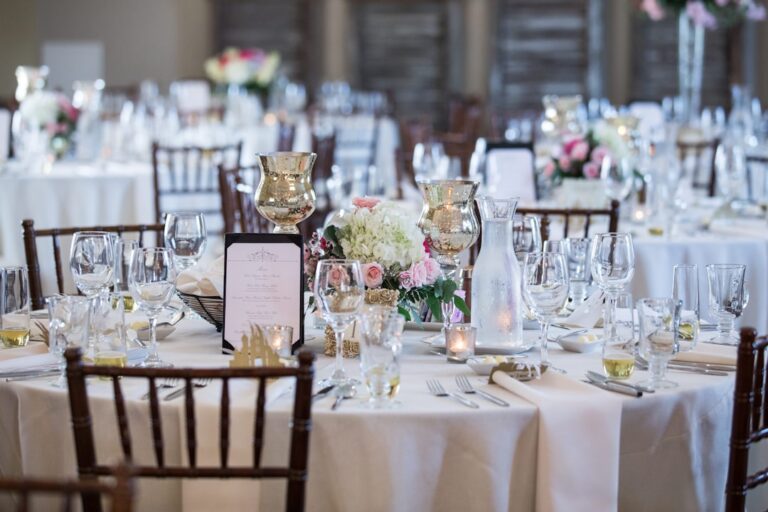
The venue itself can be the couple’s best ally in managing family expectations. A fire marshal’s capacity is not negotiable. A room that physically cannot fit more than 150 people is a fact, not an opinion, and facts are harder to argue with than preferences.
One couple in Chicago used this approach with surgical precision. The bride’s mother wanted to invite her entire mahjong group — eight women, none of whom had met the groom. The bride sent her mother a diagram of the venue with the table layout. She showed her that each table seated eight, and that the room had exactly eighteen tables. She then listed every guest who was already assigned to those tables. When her mother tried to argue, the bride pointed to the fire exit, the aisle width, and the catering kitchen access. The venue, not the bride, became the villain. The mahjong group did not make the cut.
This tactic works best when the venue is booked early. A couple who books a space before the families have fully formed their guest lists can use the venue’s capacity as the starting point rather than the ending point. A couple who books a venue too late — after the save-the-dates have been sent, after the aunts have started texting — will find that the venue’s capacity feels like a punishment rather than a boundary.
Accept that someone will be unhappy, and decide whose unhappiness you can live with.
This is the hardest step, and it is the one most couples try to skip. The desire to please everyone is strong, and the wedding industry feeds on it. But the reality is that a guest list is a finite resource. Every person who is added requires someone else to be removed. Someone will feel slighted. Someone will be hurt. Someone will not show up to the wedding because they were not invited, or because someone they love was not invited.
The couple in Portland ended up cutting the groom’s father’s poker group — four men the groom had known since childhood, men who had taught him how to play cards and fish and change a tire. The groom’s father was furious. He did not speak to his son for three weeks. But the couple made a decision: they would rather have the bride’s grandmother, who was eighty-two and could not travel easily, than four men who could attend the next poker night. The grandmother came. She sat in the front row. She cried during the vows. The poker group sent a gift and a card, and the groom’s father eventually came around, though he brought it up at Christmas dinner for two years afterward.
Have a contingency for the guest who shows up uninvited.
It happens. A cousin drives six hours and arrives at the ceremony because they assumed the invitation was implied. A college friend is in town and decides to crash the reception. A parent brings a plus-one who was not on the list, assuming the couple would not notice in the chaos.
The venue’s capacity is not a suggestion. If the fire marshal shows up — and some venues do require a headcount before the ceremony — the couple could face a fine, a shutdown, or both. The backup plan: the couple designates one person — a coordinator, a trusted friend, a sibling — whose job it is to handle exactly this situation. That person has a list of the forty most recent declines, and can identify who the unexpected guest is and whether they can be seated without exceeding the limit. If the answer is no, the designated person has a script: “We are at capacity and we love that you’re here, but we need to find you a spot at the bar down the street. We’ll bring you a plate after the toasts, or something like that.” It is not ideal. It is better than a shuttle of fire trucks.
The guest list problem does not end when the invitations go out. It does not end when the RSVPs come back. It ends when the last guest leaves and the couple looks at the room — the half-empty tables where the poker group would have sat, the front row where the grandmother cried through the vows, the friend who declined out of principle and whose absence is a small, sharp thing the groom still feels when he passes her on the street. The absent, the offended, the uninvited — they will send a gift, see the photos, be at the next wedding. The couple will remember the room held exactly as many people as it was meant to hold, and that some of the people who weren’t there are still, quietly, a presence the room couldn’t contain.

📷 Photos: Casey Chae (Unsplash), Jennifer Kalenberg (Unsplash)