The Wedding Band That Wouldn’t Stop Playing
The Wedding Band That Wouldn’t Stop Playing
The first year I started consulting for weddings, I went to a reception in a tent that had been pitched on a soggy September lawn. The band was a six-piece funk cover band from Chicago, and the lead singer was a woman in a gold sequined blazer who kept calling the bride “babygirl” over the microphone. I assumed the whole thing would be a disaster — too casual, too loud for the space, the tent walls trembling. But by 10 p.m., the bride’s mother was on the dance floor doing the splits. I’ve never trusted my first impressions of a band since.
Most couples I talk to start the search for reception entertainment the same way: they decide they want either a DJ or a band, then they look for a vendor in that category. The band people think DJs are boring. The DJ people think bands are expensive and inflexible. Neither group is entirely wrong, but neither is entirely right either. And almost no one starts out thinking about silent disco, which is a shame because it solves problems most couples don’t even know they have yet.
The West End at Hour Four
I sat in on a set from a band called The West End at a wedding in a converted firehouse in Brooklyn last fall. The room was brick and steel, terrible acoustics for anything that isn’t a full PA system, and they handled it. But the real test was hour four. By then, the guitarist had taken his jacket off, the bassist had switched to a smaller amp because the original one was overheating, and the set list had derailed entirely — they were taking requests from the crowd, playing a slowed-down version of “Get Low” that somehow worked.
The Good
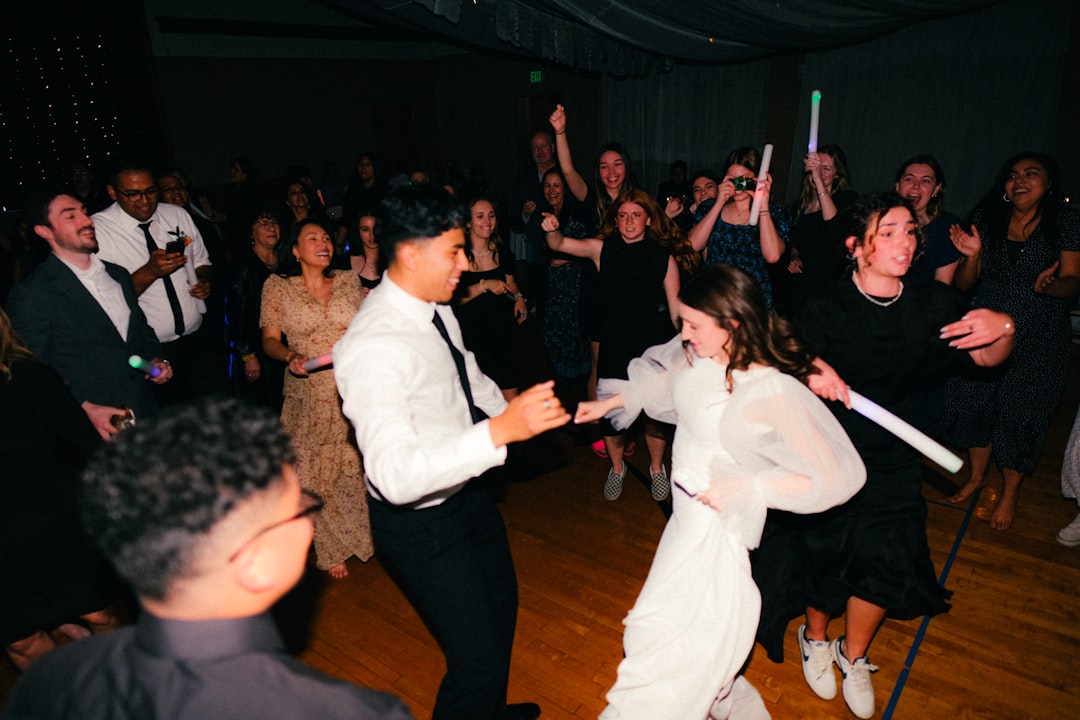
A great live band does something a DJ can’t: they read the room in real time, not through song selection but through energy. The singer notices the floor is thinning during the bridge, so she stretches the chorus. The drummer sees the flower girl is still awake at 11 p.m. and gives her a little fill to dance to. The best bands feel like they’re playing for this specific group of people, not for a generic wedding crowd. I’ve seen a band kill a packed dance floor with a cover of a deep cut from a 1970s Colombian salsa album because they could tell the bride’s extended family was from Cali.
The Bad
But a bad live band — and I mean truly bad, not just mediocre — is worse than a bad DJ, because you can’t subtly lower the volume or skip to the next track. A bad band keeps going, on the same song, for the full four-minute runtime, and then starts another one. I watched a band in a hotel ballroom in Tampa play “Brown Eyed Girl” three times over a four-hour reception because the lead singer kept forgetting which songs he’d already done. The crowd thinned out by the second encore. The hotel staff started clearing the dessert table while they were still playing.
Price is a real factor too. A decent five-piece band runs somewhere between $4,000 and $8,000 depending on your market, and that’s low-end. The good ones, the ones that show up with their own sound engineer and a lighting rig, can go $12,000+ before you ask them to play anything off an album released after 2010. For that money you’re getting energy and craft and a night that feels live and unpredictable. But you’re also getting set breaks, which can kill momentum. Most bands take two or three 15-minute breaks over four hours. If you haven’t planned for those gaps, your dance floor goes from packed to empty in under a minute.
The DJ Who Saved a Wedding From Its Own Playlist
I met a DJ named Marcus in Austin who told me, over coffee at a diner that smelled like old grease and hot syrup, that his most common job is not playing music. It’s not playing the music the couple put on their “do not play” list, which their drunk cousin will request seven times anyway. He said the hardest part of his job is staying polite while telling the same person no for the third time. He didn’t say it angrily. He said it like it was just a fact about the world, like rain in April.
DJs are better than bands at flow. They can drop the tempo for dinner, bring it up for the first dance, kill the BPMs during cake cutting, and spike it again for the open floor — all without anyone noticing the transition. A good DJ is a mood architect, not a jukebox. The bad ones, and there are a lot, just hit play on a pre-built Spotify playlist and spend the night on their phone. I watched a DJ at a vineyard wedding in Sonoma do exactly that. The playlist ended abruptly at midnight and the speakers went silent. He had to scramble to find the aux cord while the entire room waited.
The Hidden Cost
DJs are cheaper, usually $1,500 to $3,500 for a good one, but the ceiling is lower. A DJ can’t react to a room the way a live trumpet player can. There’s no moment where the singer jumps off the stage and walks through the crowd holding a microphone out to the guests. A DJ can’t give you that because it’s not a physical performance — it’s a selection. You trade raw energy for flexibility and control. For some couples, that’s the right trade. For others, it’s not a trade at all.
Silent Disco at QuietEvents Park
I first saw a silent disco setup at a wedding in a park in Portland, Oregon, where the noise ordinance cut off at 10 p.m. sharp. The couple had rented 60 wireless headphones from a company called QuietEvents for $800. I thought it would be a gimmick. It was not a gimmick. People danced in total silence from the outside, a group of thirty guests shuffling and laughing with glowing headsets on. The neighbors didn’t complain. The bride changed into sneakers at 11:30 and danced for another hour.
The thing about silent disco that most people don’t realize is the multiple-channel capability. You can run two different audio feeds at once — one channel for the older crowd playing Motown and classic rock, another for the younger crowd playing dance-pop and hip-hop. Guests can switch between them with a button on their headset. I saw a couple at a barn wedding in upstate New York do this when the bride’s uncle refused to stop requesting polka music. The uncle stayed on channel A with the polka. Everyone else switched to channel B. It was the most peaceful solution to a wedding playlist conflict I’ve ever witnessed.
The Logistics That Kill the Romance
The catch is the rental time window. Most companies deliver the headsets the day of the wedding and pick them up the next morning, but you’re paying for a full weekend block whether you use it or not. And the batteries last about six hours — long enough for the reception, but not long enough for an after-party that goes until 3 a.m. A couple I worked with in Denver learned this when the headsets started dying at 1:30 a.m. and they had no backup plan. The last hour of their wedding was just people standing around in a quiet room with dead headphones, looking confused.
Silent disco also doesn’t look like anything in photos. The dance floor photos from that Portland wedding are just people in suits and dresses standing still, dancing invisibly. If you care about your wedding album having lively dance-floor shots, this might not be the move. But if you care about the experience itself — about a dance floor that stays full until the very end because the music never has to stop for a noise complaint — it’s worth considering.
The LA Warehouse Handoff
A few years ago I went to a wedding in a warehouse in Los Angeles that started with a live band for the first two hours, then switched to a DJ for the last three. The band played funk and soul covers, got the crowd warmed up, then took a break and never came back. The DJ took over with a seamless transition, kept the energy going, and played until the venue kicked everyone out at 1 a.m. It was the best of both worlds, and it cost the couple about $10,000 total — the band was $6,500, the DJ was $2,000, and the sound tech to coordinate the handoff was another $1,500.
That handoff is the hardest part. The band and the DJ need to coordinate — the band’s last song, the DJ’s first song, no awkward silence, no feedback from a hot mic. It can go wrong. At a wedding in Nashville, the band’s sound engineer unplugged the mains without telling anyone, and the DJ’s first track came through at half volume for the first thirty seconds while he scrambled to adjust. The crowd didn’t seem to notice, but the couple noticed. They were watching the clock.
The Question Nobody Asks
Almost every couple I meet focuses on the cost of entertainment without considering the cost of the wrong choice. A cheap DJ who plays the wrong songs at the wrong volume for four hours will cost you more in memories than a good band at twice the price. But a band that can’t stop for the toasts, or won’t take requests, or plays the same set they’ve played at every wedding this summer — that’s also a waste of money. The secret is not the format. It’s the person running it.
Before you book anyone, ask them what happens when the dance floor is empty at 10:15 p.m. The good vendors have an answer that doesn’t start with “well, that rarely happens.” The bad ones don’t have an answer at all.
📷 Photos: Wesley Tingey (Unsplash), Jeppe Mønster (Unsplash)