How to Draw on Cherokee Beadwork Patterns for Modern Wedding Jewelry
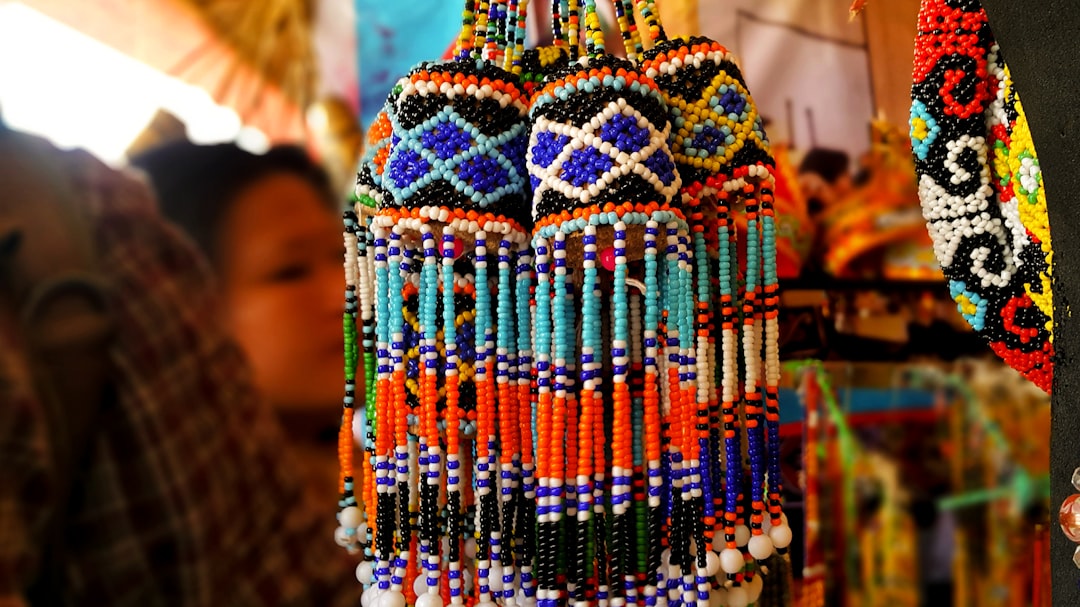
The glass beads catch the overhead light of the studio, and Priya, a jewelry designer who has been working with Indigenous-inspired motifs for seven years, flicks a finger across a string of Czech-cut seed beads in the color known as “old red.” It is not a bright red. It is the color of dried clay after rain, slightly brown, slightly warm. “That’s the first thing most people get wrong,” she says. “They see Native American beadwork and think bright turquoise and fire-engine red. The real palette is subtler. It comes from what was available to trade, and what could be made from earth pigments.” She holds up a strand of Venetian glass beads from the 1700s, tiny and uneven, and the room goes quiet for a second.
The truth is that Cherokee beadwork has been influencing non-Indigenous jewelry design for longer than most people realize—but often in ways that strip the original patterns of their meaning. The challenge for a modern wedding jeweler or a bride-to-be who wants to reference this tradition respectfully is to understand what the patterns actually meant before deciding how to adapt them.
The most recognizable Cherokee beadwork pattern is the seven-pointed star or the seven-sided geometric figure, which represents the seven clans of the Cherokee Nation—Long Hair, Blue, Wolf, Bird, Deer, Paint, and Wild Potato. It is not a decorative choice. It is a statement of belonging. In wedding jewelry, this translates well into a pendant or a center stone setting. The seven-pointed star can be rendered in rose-cut diamonds or in matte gold bezels, as long as the shape remains unmistakable. A jeweler in Asheville, North Carolina, known for his work with Southeastern tribal motifs, has been making seven-pointed star wedding bands for a decade. He says the hardest part is convincing brides that the star does not need to be symmetrical. “It’s not a compass rose,” he explains. “It’s organic. The points are different lengths, depending on who made it and when. That’s the beauty. You can’t clean it up.”
Cherokee beadwork has a consistent color language that is not arbitrary. White represents peace, purity, and the East. Red stands for war, blood, and the South—but also for spiritual power and victory. Black is the West, death, and the underworld. Blue is the North, trouble, and also the sky. Yellow is the sun and the sacred fire. In wedding jewelry, white is the obvious foundational color, but the real impact comes from adding a single red bead or a blue one at a key point. A bracelet that is predominantly white pearls with one red bead at the clasp changes the entire energy of the piece. It is a small detail.
This is the detail most design houses get wrong. The Eastern Band of Cherokee Indians, based in North Carolina, developed a distinct beadwork style that uses smaller, more intricate geometric patterns and tends toward symmetrical designs. The Oklahoma Cherokee, who were forcibly relocated during the Trail of Tears, developed a freer, more flowing style influenced by Plains tribes they encountered. A wedding necklace that uses the tight, repeating diamond patterns of the Eastern Band will feel structured and formal. One that uses the larger, open flowers and scrolls of the Oklahoma style will feel more organic and romantic. Both are legitimate, but they are not interchangeable. A designer should know which tradition they are referencing and why.
Traditional Cherokee beadwork uses a double-weave method where two separate layers of beads are stitched together, creating a pattern that appears to float above the background fabric. This technique has a direct parallel in jewelry making: the basket-weave setting, where a second layer of metal or gemstone is suspended above the primary band. A jeweler in Santa Fe has been experimenting with this by placing a thin sheet of etched gold over a sterling silver band, then setting small diamonds in the gold layer so they appear to hover. The visual effect is nearly identical to a double-weave beadwork cuff. Close enough, anyway.
In Cherokee beadwork, the border patterns are often more significant than the central image. A rosette in the middle of a medallion might be purely decorative, but the concentric rings around it—the zigzag lines, the tiny crosses, the alternating colors—are where the clan symbols and spiritual meanings reside. A wedding ring designed with a plain center band but a heavily patterned edge, or a pair of earrings with a simple drop but a detailed hoop, will read as authentically inspired by this tradition in a way that a big central motif never will.
The earliest Cherokee beadwork used shell, bone, and stone—the beads were carved, not manufactured. After European contact, glass seed beads became the primary material, and they remain the preferred choice for traditional artisans because they catch light differently, reflecting the movement of the wearer. For wedding jewelry, the decision between faceted gemstones and smooth glass beads is not just an aesthetic one. Gemstones, especially diamonds and sapphires, reflect light in sharp, angular flashes. Glass beads, even high-quality Venetian or Czech varieties, produce a softer, more diffuse glow. A pendant that uses faceted white topaz as the central stone but surrounds it with matte glass beads in the same color will have two distinct light behaviors in one piece. You get two different feelings from the same necklace.
This is a tradition that surprises most outsiders. In many Cherokee beadwork pieces, especially those made for ceremonial or wedding purposes, the artisan intentionally includes one bead of the wrong color or in a slightly off position. It is not a mistake. It is a deliberate imperfection that acknowledges that only the Creator is perfect. This translates beautifully into wedding jewelry: a ring with a tiny diamond that is not centered, a necklace with one bead that is a slightly different shade of blue, a clasp that is turned at a slight angle. It is a quiet, personal detail that gives the piece humility. A bride who knows to look for it will feel connected to the maker in a way that a perfectly uniform piece cannot replicate.
There is a growing network of Cherokee beadwork artists who take custom commissions, and the price is often comparable to mid-range commercial jewelry. A wedding planner based in Portland who specializes in culturally intentional ceremonies has worked with an Eastern Band beadworker named Tobias for three years. “A bride came to me wanting something that referenced her grandmother’s Cherokee heritage,” she says. “She was going to buy a mass-produced bracelet from a department store. I put her in touch with Tobias. He made her a pair of earrings with her clan’s pattern—the Deer clan—in white seed beads and abalone shell. It cost her less than the department store bracelet, and she cried when she opened the box.” The direct commission route also ensures that the artist’s community benefits from the transaction. That’s the thing, really.
There is a specific subset of Cherokee beadwork created during and immediately after the forced removal of the 1830s. These pieces are smaller, more restrained, and often feature a single repeated motif—a tear, a broken circle, a rain pattern. They were made in camps and on the march, using whatever beads could be carried. Some contemporary Cherokee couples choose to incorporate a single element from this period into their wedding jewelry as a way of acknowledging the survival of their family line. A necklace made with a single broken-circle motif in black and white beads, worn only during the ceremony, is a powerful statement. It is not traditional in the sense of pre-contact beadwork, but it has become its own tradition in the last generation.
This is the principle that separates respectful adaptation from hollow trend-chasing. Cherokee beadwork patterns were not designed to wrap around a finger or dangle from an ear. They were laid flat on fabric, meant to be seen from a single angle. The challenge of wedding jewelry is to translate these flat, two-dimensional patterns into three-dimensional forms without distorting them. A ring that tries to force a seven-pointed star around a curved band usually ends up looking like a squashed spiral. A better approach is to keep the pattern flat on the top of the ring, letting the band itself be plain, or to use the pattern as a motif that appears only on the front of a pendant, with the chain or setting serving as a neutral frame. The pattern should never be stretched or compressed to fit the jewelry shape.
The most successful instances of Cherokee beadwork in contemporary weddings happen when the jewelry is allowed to be the focal point. A bride wearing a simple silk sheath dress and a pair of intricately beaded Cherokee-style earrings will look like the jewelry belongs. The same earrings worn with a heavily beaded lace gown will compete and cancel each other out. The same principle applies to the groom: a beaded cuff or a seven-pointed star lapel pin works best against a plain suit, not a patterned vest. The beadwork needs visual breathing room.
In Cherokee culture, beadwork is often given as a gift, not purchased for oneself. A wedding necklace or pair of earrings made in the Cherokee tradition carries a different weight when it comes from the hands of a family member or a close friend. Priya recalls a client whose grandmother had started a pair of beaded earrings before she passed away, leaving them unfinished. “The bride brought them to me and asked if I could finish them,” she says. “I matched the beads as close as I could. The grandmother had used a specific old red that is hard to find now. I found a supplier in the Czech Republic who still makes it—or something like that, a little place. When the bride put them on at the wedding, everyone who knew her grandmother recognized the color. It was like she was there.”

📷 Photos: Ervan Sugiana (Unsplash), Leiada Krözjhen (Unsplash)