The Year the Bridesmaids Wore Whatever They Wanted, and One Bride Almost Lost It
The Year the Bridesmaids Wore Whatever They Wanted, and One Bride Almost Lost It
It started with a Pinterest board and ended with a group text that nobody wanted to respond to. By the time Lauren Choi finally picked a date for her bridesmaids to go dress shopping together, three of the six women lived in different cities than the one where the wedding would take place, one had just started a new job with no PTO, and another was eight weeks pregnant and not ready to tell anyone. The mismatched dresses were supposed to solve all of this. Instead, they created a new set of problems nobody had prepared for.
The concept itself wasn’t new. By 2024, the fully uniform bridal party—same dress, same color, same silhouette—had been losing ground for years. What changed heading into 2025 was the degree of freedom being offered. Not just different necklines in the same fabric, but completely different dresses in different colors from different brands, held together by nothing more than a shared saturation level or a designer’s vague concept of a “tonal palette.” And for a generation of brides who’d watched their older sisters spend $400 on a dress they’d never wear again, it sounded like the obvious answer. Until someone had to actually coordinate it.
“I told everyone just to pick a long dress in dusty blue,” Choi said, sitting at a coffee shop in Brooklyn six months after her wedding. “That’s literally all I said. I thought it was foolproof.” The bill for that assumption came due slowly, over the course of several months, in the form of a color that looked different on every screen, a fabric that photographed like a completely different shade depending on the time of day, and one bridesmaid who showed up at the rehearsal dinner in a dress that was technically dusty blue but read, in direct sunlight, as lavender. Choi still isn’t sure how that happened. She’s not sure she wants to know.
“The Color of an Old Golf Course”
The first mistake, as Choi tells it, was the word “dusty.” To her, it meant a muted, slightly grayed blue—the kind of color that sits quietly in photos and doesn’t compete with the florals. To one bridesmaid in Seattle, it meant a shade that leaned toward slate. To another in Chicago, it read as a pale denim. And to the pregnant bridesmaid, who had the least tolerance for shopping around, it meant the first thing she found on Amazon that had the word “dusty” in the title. That dress arrived and was, by her own description, “the color of an old golf course.” She wore it anyway, because she had no energy left to care.
What Choi hadn’t accounted for was the way fabric absorbs and reflects color differently depending on its material. A chiffon dress in dusty blue looks almost gray in dim light. A crepe dress in the same color leans more blue. A satin dress, if it can even be called the same color, catches every bit of light and sends it back amplified. In the wedding photos, the bridesmaids are standing in a row that goes from almost-gray on the left to almost-lavender on the right, with the golf-course dress holding down the middle like an anchor. Choi’s mother noticed immediately. “She asked me if we ran out of the same dye halfway through,” Choi said.
The Group Chat That Became a Liability
The mismatched dress strategy relies heavily on communication, but communication among six women with different schedules, budgets, and body types is not a neutral process. Choi set up a group chat in November, ten months before the wedding, with a single rule: no discussion of other wedding details. Just dresses. For two weeks, the chat was quiet. Then one bridesmaid sent a link to a dress she liked, and another bridesmaid responded that she’d already bought something similar, and a third bridesmaid said she hadn’t started looking yet because she was waiting to see what everyone else chose. The standstill lasted another month.
By January, Choi had sent a follow-up message: could everyone please have a dress selected by February 1? Three of the six did. The others missed the deadline by weeks. One bridesmaid, living in Austin, bought three dresses online and returned two, which took another month because the return label was for a store that had closed. Another bridesmaid, the pregnant one, waited until she knew her size would stabilize, which it never did. She ended up buying a dress two sizes too big and having it altered three times, at a total cost of $185 in alterations alone. Choi didn’t know about any of this until after the wedding, when the bridesmaid finally told her.
The Terracotta Dress That Arrived Six Weeks Late
The original plan was more ambitious than dusty blue. Choi had initially wanted a full tonal range: dusty blue, sage green, terracotta, and a soft peach, all within the same muted family. She’d seen it in a magazine spread and thought it looked effortless. The reality was that finding four colors that sat together quietly was harder than finding four colors that clashed. One bridesmaid, a graphic designer by trade, sent Choi a color wheel and explained the concept of complementary colors versus analogous colors. Choi nodded along and told her to just pick something she liked.
What happened instead was that the bridesmaid in sage green bought a dress that leaned more olive, which looked fine next to the dusty blue but terrible next to the one who showed up in lavender. And the terracotta dress, ordered from a small Etsy shop in Turkey, arrived six weeks late and was, according to the bridesmaid who wore it, “the color of a pumpkin that sat out too long.” She wore it anyway because she had no backup. The bride didn’t notice until the rehearsal dinner, when the four bridesmaids stood together for the first time and the colors did not, as the magazine spread had promised, “sing together.” They argued.
The One Dress That Cost More Than the Bride’s
Choi’s own wedding dress cost $1,200, purchased from a sample sale in Manhattan. One bridesmaid’s dress, a custom-made silk piece from a boutique in Los Angeles, cost $1,400. No one found this out until after the wedding, when the bridesmaid casually mentioned it and the room went quiet. The bride didn’t ask her to spend that much—no one had asked her to spend that much—but the problem with a mismatched dress policy is that there’s no upper limit implied. A bride who says “wear whatever you want” cannot also say “but don’t spend more than I did” without undermining the premise.
The bridesmaid later said she’d wanted something she could wear again, something that felt like an investment rather than a costume. She’d worn the dress once before the wedding, to a work event, and planned to wear it again. But the cost had created an unspoken tension. Other bridesmaids had spent between $80 and $200, and the discrepancy, while never discussed directly, was felt. At the reception, a cousin of the groom asked the $1,400 bridesmaid if she was the maid of honor. She wasn’t.
What the Photos Actually Look Like
The photographer, a woman named Riley Park who shoots about thirty weddings a year, said mismatched bridal parties are the most common request she’s seeing for 2025, and also the most likely to produce results the bride doesn’t expect. “The idea is that it looks organic and collected, like everyone showed up in something that felt like them,” Park said. “But the reality is that organic and collected requires more coordination than matching. You’re essentially designing a color story with people who don’t have your eye.”
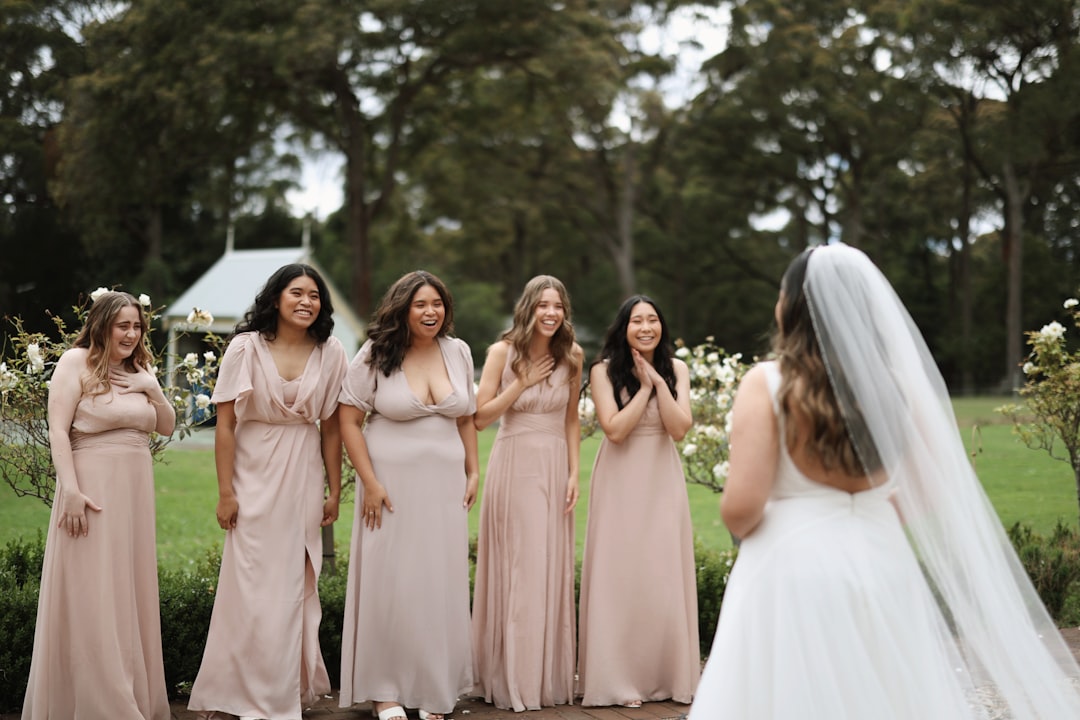
Park’s advice, which she gives to every bride who brings up mismatched dresses, is to pick one fixed element and make it non-negotiable. Same length. Or same fabric. Or same designer. Not all three, but one. Something that anchors the group visually even when everything else shifts. Choi had none of these. Her bridesmaids’ dresses ranged from floor-length to mid-calf, from chiffon to crepe to satin to something that looked like it might be polyester. In some photos, the dresses look like they belong to different weddings entirely. In others, the texture differences create a visual noise that distracts from the faces.
“She’s not unhappy with the photos,” Park said. “But she’s not thrilled either. And I think she blames herself for not being more specific.”
The One Photo That Worked
There is one photo from the day that Choi actually loves. It’s not the formal shot of the bridesmaids lined up—that one she scrolls past. It’s a candid moment during the reception, when the bridesmaids are standing at the bar together, laughing at something, and the dresses are visible in the background of the frame. In that photo, the colors don’t look mismatched. They look like they landed exactly where they were supposed to land, because nobody was posing, and nobody was thinking about the dresses. The dusty blue, the sage green, the lavender, and the pumpkin all read as people, not as problems. Choi said she’s had that photo printed and framed, but she keeps it in her office, not in the living room.
A Swatch and a Price Cap
Sitting in the coffee shop, Choi ordered a second latte and considered the question. If she had to do it over, she said, she would have given each bridesmaid a swatch. A physical piece of fabric, mailed to each address, with a note that said “this is the color.” No screen, no interpretation, no “dusty blue” meaning different things to different people. She would have set a price cap explicitly, even if it felt awkward. She would have asked the pregnant bridesmaid to tell her earlier, so they could have chosen a stretchy, forgiving fabric together rather than leaving her to figure it out alone.
She would also have designated one person—not the bride—to manage the group chat. “I didn’t want to be the one people had to report to,” she said. “But if I’d asked a friend to just track who was where and follow up with people, it would have saved so much time. I spent so many nights scrolling through dress websites feeling like I was failing at something that was supposed to be easy.”
Whether any of this changes how the next bride plans her bridal party is up to her. But before the message goes out to the group chat, it’s worth knowing that “wear whatever you want” is not a shortcut. It’s its own kind of work, with its own price tag, and its own unexpected results—some of which will end up framed in an office, not a living room, and some of which will end up in a conversation at a coffee shop six months later, when nobody can remember exactly what shade of blue they were supposed to be wearing anyway.
📷 Photos: Joeyy Lee (Unsplash), Joeyy Lee (Unsplash)