
I Tried to Negotiate a Sunset Photoshoot on a Working Organic Farm in the Catskills — Here’s What Actually Happened
I Tried to Negotiate a Sunset Photoshoot on a Working Organic Farm in the Catskills — Here’s What Actually Happened
I’ll start by saying I’m not usually the person who tries to negotiate with farmers. I’m the person who pays the listed price for a CSA box and says “thank you” when they hand it over, no questions asked. But when I found Stone Hollow Farmstead’s website — a 200-acre organic operation in the western Catskills, about three hours from the city — I convinced myself this was different. This was a venue search, not a vegetable purchase. And venues, as everyone knows, are negotiable.
Which is how, on a Tuesday afternoon in late June, I found myself standing in the farm’s gravel parking lot next to my fiancé Alex, both of us sweating through our shirts, trying to explain to a woman named Margaret why we should be allowed to take wedding photos in her rye field at golden hour for free.
I want to be clear: I was wrong about almost everything going into this. But the thing I was wrongest about — the thing that nearly derailed the whole idea — was how I thought the conversation would go.
The Pinterest Idea and the Late-Night Email
The idea came from Pinterest, which is where bad ideas usually come from. I’d seen a photo of a couple standing in a wheat field at sunset, the light hitting the grain in that specific way that makes it look like they’re standing in a painting. The caption said “Catskills farm wedding” and I thought, we can do that.
I spent an evening researching farms in the region. Stone Hollow came up because they have a farm store and host occasional events — a harvest dinner, a wreath-making workshop — but they don’t list themselves as a wedding venue. That seemed like an advantage. If they don’t have a wedding price sheet, I reasoned, there’s no baseline. Maybe they’d let us use the space for a hundred dollars and a promise to buy a bunch of apples.
I drafted an email. It began: “I’m writing to inquire about the possibility of using your beautiful farm as a photography location for our small wedding.” I deleted “beautiful.” Rewrote it as “I love what you’re doing at Stone Hollow.” Sent it at 11 p.m. on a Thursday, which should have been my first sign that I was being impatient and dumb.
Margaret replied on Monday. She was direct: “We don’t typically do this. But we could talk about it if you want to come by and see the property.” She suggested Tuesday at 2 p.m. I said yes before thinking about whether Alex could get off work.
Phoenicia, a Missed Exit, and a Hot Parking Lot
We left Brooklyn at 11 a.m. Google Maps said two hours and forty-five minutes. It took three and a half. There was construction on I-87 — a lane closure that turned the highway into a parking lot for twenty minutes. Then we missed the exit for Route 28 because I was looking at my phone instead of the signs, and we had to do a loop through a town called Phoenicia that was charming in a way that made me angrier about being late.
We pulled into the farm at 2:17. The gravel lot was empty except for a muddy pickup truck and a Subaru with a “COEXIST” sticker that looked older than me. The farm store was a white barn with a handwritten sign that said “STORE HOURS: SAT & SUN ONLY” — which I’d somehow missed on the website. I’d imagined walking in, buying something, establishing goodwill. Instead we were standing in a hot parking lot, late, with nothing in our hands.
Margaret came out of the house — a farmhouse, white with black shutters, a porch with a rocking chair — and waved. She was maybe sixty, wearing jeans and a t-shirt that said something about a 5K. She didn’t seem annoyed we were late. She said, “You made it,” like she wasn’t sure we would.
The Stunted Rye and the Peeling Paint
She took us on a walk. Not a tour — a walk. She didn’t point out features or talk about the property’s potential. She just walked and talked about what she’d planted and when, and what was working and what wasn’t. The rye field I wanted to shoot in? She’d seeded it in April, and it had grown uneven because of a dry patch in May. Part of it was stunted. She pointed to a section that was waist-high and a section that was knee-high and said, “This is the part nobody puts on the website.”
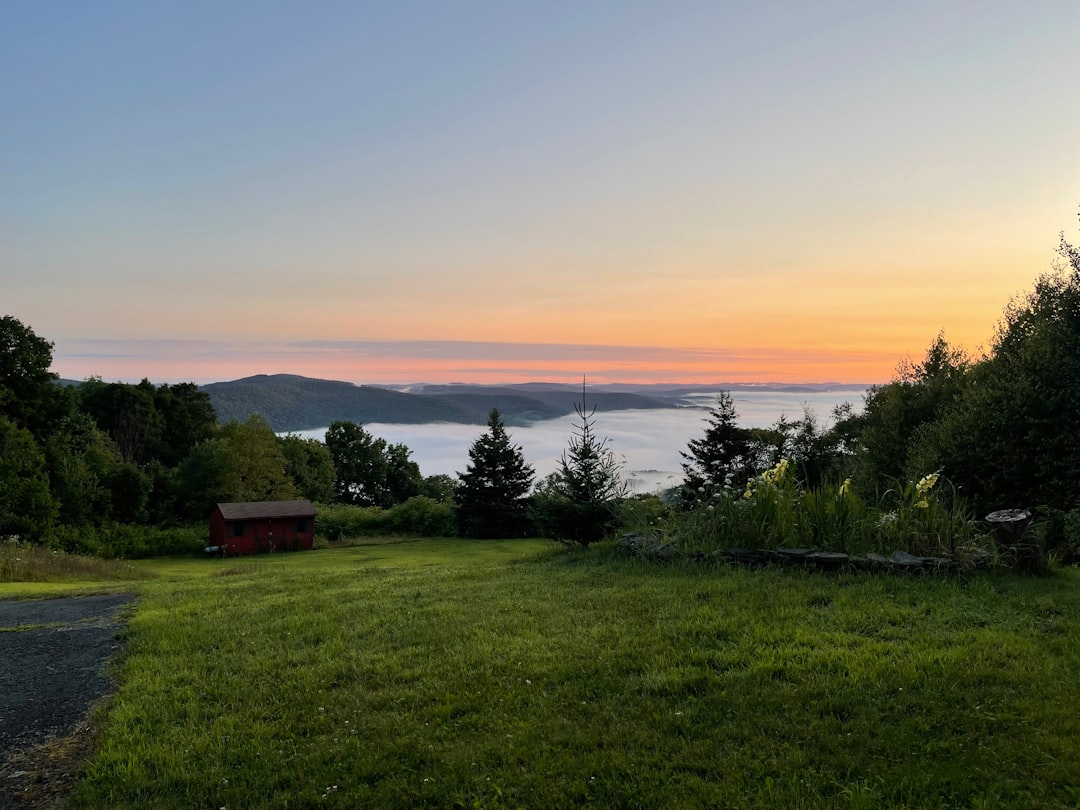
The land sloped gently toward a creek — the Little Beaverkill, she called it — and on the far side was a pasture with two elderly-looking cows. The light was bright and flat, the kind of midday glare that makes everyone squint in photos. I tried to picture it at 7 p.m., the golden hour I’d been fantasizing about, and I couldn’t quite get there. The property was beautiful in a real, un-curated way. But it wasn’t the farm from the Pinterest photo. It was a farm that had a bad yield one year and a tomato blight the next and a tractor that was older than I was.
I wanted to like it anyway. I wanted to be the kind of person who could see past the stunted rye and the peeling paint on the barn door. But standing there, sweating, I felt a gap open between the idea I’d built and the place itself.
The Thousand-Dollar Fact
We sat on the porch. Margaret brought out a pitcher of water with mint in it. I tried to do what I’d practiced in my head: express appreciation, mention our budget, ask if there was flexibility.
I said: “We really love the feel of the property. We’re keeping things pretty simple — just the two of us and a photographer, maybe thirty minutes. We’re wondering if there’s a way to work out a fee that’s manageable for us.”
She said: “The fee is a thousand dollars.”
It wasn’t a negotiation. She said it the way you say a fact — the farm’s elevation, the average rainfall. No room for bargaining, no sense that she was testing me. I asked if that was standard for photography-only visits. She said it was what she’d decided after the last couple who’d asked, who’d trampled a section of her carrot bed trying to get a shot over the creek. She didn’t sound angry about it. Just clear.
I said we’d need to think about it. She nodded and said to let her know by the end of the week because she was planning to mow the rye field on Saturday. That’s the part that got me — not the price, but the reminder that to her, this field was a crop, not a backdrop. She was going to mow it. For hay. The perfect golden-hour shot I’d imagined was on a timer I didn’t control.
The Photographer’s Question from the Car
I called our photographer, a woman named Jen who’d done a friend’s wedding, from the car on the way back. I told her the situation — the thousand dollars, the mowing deadline, the stunted rye. She was quiet for a second and then said, “That’s actually not bad for a private farm. But I want to ask you something: do you actually want photos in a field? Or do you want photos that look like a field?”
I didn’t have an answer then. I think I wanted photos that looked like a field — the idea of a farm, the idea of rustic simplicity. The actual farm, with its uneven growth and its honest farmer and its thousand-dollar price tag, was harder to romanticize.
Jen also pointed out something I hadn’t considered: sunset at a farm in June means bugs. Flies, mosquitoes, gnats — she had a whole speech about it, which I later learned was based on a shoot where the couple had to pause every thirty seconds for someone to swat a mosquito off the bride’s forehead. She suggested we look at a state park instead. “Same golden hour, fewer insects, and you can buy a day pass for eight dollars.”
The Saturday Visit and a Bad Phone Photo
We ended up going back, though. Not for a photoshoot. For a Saturday, to see the farm store when it was open. I wanted to see the place when it wasn’t about the negotiation, when I wasn’t trying to get something from it.
The store was small — one room with a counter, a cooler, and shelves holding jars of honey and pickles and bags of pancake mix. Margaret was behind the counter, ringing up a woman who’d bought three pounds of tomatoes. She recognized me, said, “Oh, you came back. The rye field is still standing, if you’re wondering.” She said it like a joke. I laughed and bought a jar of honey and a bag of cornmeal. It cost twelve dollars total.
I walked out to the field while Alex paid for a bottle of cider. The sun was high and harsh — not golden at all — but I could see the shape of it, how the field fell toward the creek, how the cows were standing in the same spot. It was just a field. But it was a field I’d spent a week thinking about, and that gave it a weird kind of gravity.
I took a photo with my phone. It looked terrible. Overexposed, no composition, a power line cutting through the top corner. I didn’t delete it.
An Apple Tree in Columbia County
For the record: we didn’t do the farm shoot. We didn’t go to the state park either. What we did was take photos at a friend’s property in Columbia County — a backyard with an old apple tree and some wildflowers, no fee, no negotiation, no thousand-dollar price tag. The light was fine. The bugs were present but manageable. The photos are good — not the ones from Pinterest, but ours. Alex is squinting in one because the sun was in his eyes, and I’m laughing at something the dog did, and the apple tree is just barely in frame.
I don’t regret the farm trip. I regret the way I approached it — the idea that I could negotiate a sunset photoshoot the same way I’d negotiate a used car, like the farmer’s time and crop and land were things I could talk my way into for less than they were worth. Margaret was right to charge a thousand dollars. If anything, she was undercharging. Someone who has to mow around your photo setup, who has to wonder if you’re going to step on the carrots, who has to clean up after you — that’s labor. I didn’t see it as labor because I was seeing the farm as a backdrop.
I still think about the field sometimes. Not the photo shoot I wanted. Just the field itself, with its stunted rye and its honest lines and its farmer who told me the truth about what it was. I’m already planning my next visit — just to the store, not to negotiate anything.
📷 Photos: Erika Zhuravskiy (Unsplash), Moriah Wolfe (Unsplash)