How to Build Low-Cost Centerpieces With Thrifted Vases and Dyed Silk Ribbons
How to Build Low-Cost Centerpieces With Thrifted Vases and Dyed Silk Ribbons
The idea arrived at a moment most people wouldn’t remember. A Saturday morning in July, at a charity shop in a town that doesn’t get mentioned in wedding magazines. The shelves held six identical green glass vases, all from the same funeral-home clearance lot, priced at a dollar each. They were the kind of thing nobody picks — too short for a proper bouquet, too heavy to carry home without a bag, and exactly the same shape as every other vase on the shelf. The sort of object that sits on a shelf for months before someone finally buys it to hold paintbrushes.
Somewhere between the saucepans and the board games, the thought arrived: what if nobody at a wedding cared whether the vases matched? What if the intentional mismatch became the point?
A Saturday Morning in July
A typical wedding centerpiece package from a rental company in most mid-sized cities starts around forty dollars per table — glass, votive, flowers, maybe a candle, delivered and picked up. For ten tables, that’s four hundred dollars before tax, before delivery fees, before the deposit. The thrifted-vase alternative works out to roughly three dollars per table, including ribbon, before the flowers.
Here is the trade-off: it takes time. Not skill, but time. The weekend spent driving between charity shops. The hours of washing. The decision fatigue of choosing which twenty vases actually belong in the same room.
What Stays, What Gets Left on the Shelf
Not all thrifted vases are worth bringing home. Experienced thrifters look for three things first: a stable base, a mouth wide enough for a bouquet — at least three inches across — and glass that isn’t etched. Those permanent logos and decorative patterns fight the ribbon treatment. Clear, simple, unmarked glass takes dye best.
A fourth criterion matters more than most first-timers expect: weight. Lightweight vases tip over when the flowers are uneven. A vase that feels substantial in the hand is worth the extra dollar.
Cool Water, a Little Vinegar, and Patience
Silk ribbon takes dye differently than polyester or cotton. The color absorbs fast — too fast, if the water is hot. Renata Tominaga, a silk-dye specialist in Portland who supplies small wedding shops, describes the process simply: “Cool water, a little vinegar, and patience. If the water is warm, the dye hits the silk all at once and the color goes blotchy. Let it sit for an hour. Honestly, that’s the whole secret — just don’t rush it. I don’t know, maybe some people have a faster way, but this works.”
The practical steps: start with undyed or white silk ribbon, use fiber-reactive dye formulated for protein fibers, rinse in cool water with a splash of white vinegar until the water runs clear, and hang dry away from direct sunlight. A single yard of ribbon per vase is enough for two wraps and a small bow. A spool of twenty-five yards costs roughly the same as one rental centerpiece.
Burgundy Next to Blush
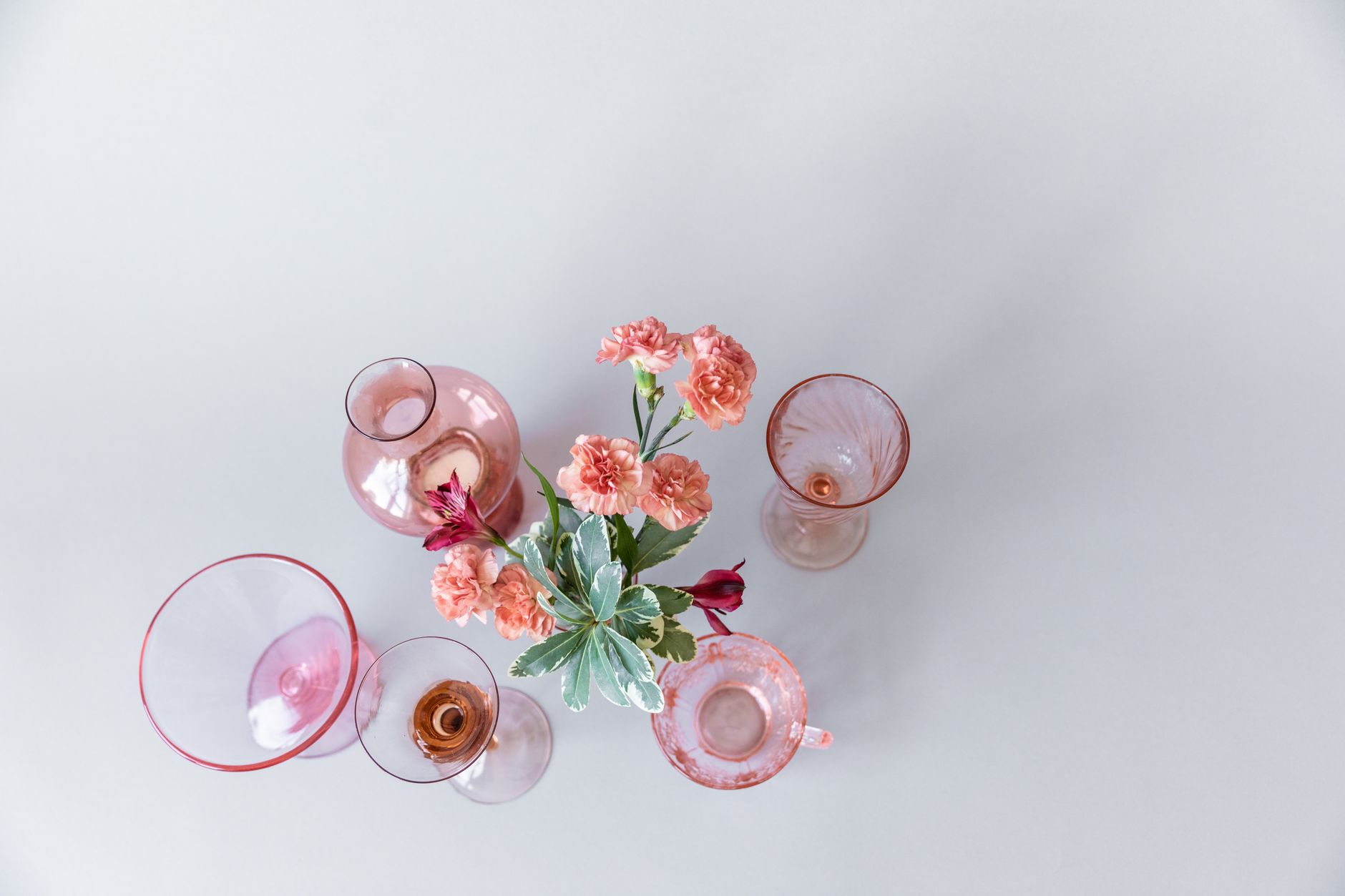
The most effective approach is not “every vase gets a different ribbon.” It is “one ribbon color, three to five shades of that color.” A deep burgundy ribbon ties around a clear glass vase beside a dusty rose ribbon on a pale green vase beside a blush ribbon on a cobalt vase. The shared color family holds the table together. The shades and vase shapes create the variation.
A couple who tried this for a September wedding in Portland — the bride’s mother had collected the vases over six months of Sunday thrifting — ended up with fourteen vases across seven tables, each wrapped in two layers of a single ribbon color in graduated shades. The result photographed as a single intentional look, not as random thrifted objects.
The ribbon color matters more than the vase color. A warm-toned ribbon — rust, blush, ochre, terracotta — reads as cohesive even on vases of different origins. Bright primary colors read as disjointed unless the vases themselves are uniform, which defeats the purpose.
Two Phases, One Week Apart
Ribbon can be cut and dyed weeks ahead. The flowers cannot. The assembly therefore splits into two phases.
Two to three weeks before: dye all ribbon, cut to equal lengths, and store in sealed bags. One week before: wash all vases — vinegar and hot water dissolve what soap won’t. The day before: set up each vase with its ribbon, placed dry to avoid water marks and mildew. The morning of: add water and flowers. A single stem per vase works better than a full bouquet when the vases are mismatched, because the variation in vase size and shape already provides visual interest.
The Controlled Chaos
The word “mismatched” suggests a casual, slightly chaotic table. In practice, the chaos is the most controlled element. The mismatched look requires curation, not indifference.
A group of vases that are all the same height, all the same width, all the same shade of glass, but from different sources — this does not read as mismatched. It reads as sloppy. The effect works when the shapes vary clearly: one short and round, one tall and narrow, one flared, one squared. A round vase and a square vase on the same table signal intentional variety. Two round vases of slightly different heights from different shops signal “these were the two that were cheapest.”
The same principle applies to the ribbon. If every vase wears the same ribbon tied the same way, the mismatch disappears. If every vase wears a different ribbon tied a different way, the table looks like a craft store exploded. The middle ground — same tie technique, same color family, different shades — is where the effect lands.
One Hundred Sixty-One Dollars
A realistic breakdown from a couple who did this for a sixty-guest wedding in a rented community hall in Columbus, Ohio: twenty-one vases from three charity shops over four weeks for twenty-seven dollars; one fifty-yard spool of undyed silk ribbon for thirty-two dollars; a single packet of fiber-reactive dye in burgundy for nine dollars; a second packet in rose for nine dollars; table flowers from a wholesale market — dahlias, spray roses, a few stems of eucalyptus — for eighty-four dollars. Total for centerpieces: one hundred sixty-one dollars. The rental quote for comparable centerpieces from the hall’s preferred vendor had been six hundred twenty, plus delivery.
Guests Noticed the Vases
One thing that surprised the couple: guests commented on the vases. Not the flowers. The vases. Several people asked where the vases came from, assuming they were designer pieces. The couple told the truth — a charity shop, a Saturday, a dollar each — and the response was not pity but interest. Three guests later admitted to driving to charity shops themselves to try the same approach for their own upcoming events.
The one thing that went wrong: a ribbon came untied during the reception, slipped into the water, and bled pale pink into the vase. The couple noticed during cleanup. Nobody noticed during the event.
📷 Photos: Piermario Eva (Unsplash), RDNE Stock project (Pexels)