Using vintage postage stamps as escort card magnets on a suspended map backdrop
Using vintage postage stamps as escort card magnets on a suspended map backdrop
The idea started with a single stamp — a 1963 Hungarian issue, twelve forint, depicting a globe in deep cobalt. A guest’s first name was written on the back in a fine-tip silver pen. A tiny disc magnet was glued to the reverse. And that one small object sat on a table for months before the wedding, waiting to see if the concept would hold together.
It did. But not in the way anyone initially expected.
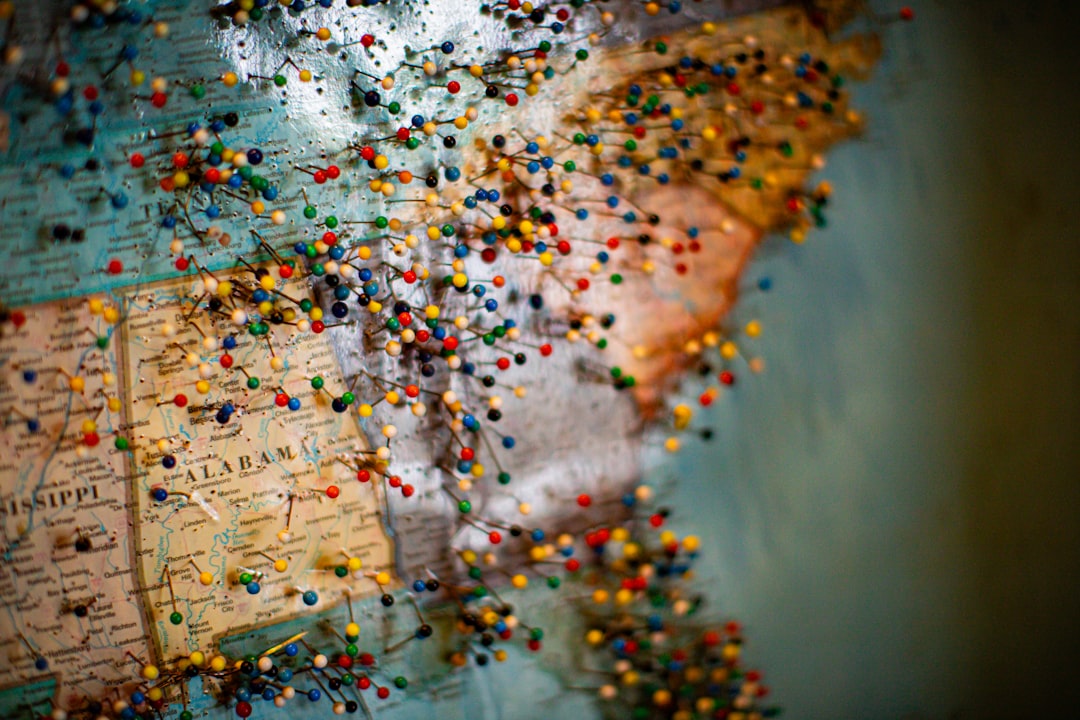
The suspended map backdrop — a 3×2-meter canvas print of a 1902 Mercator projection, hung from a thin brass rod — was the structural half of the equation. The stamps were the functional half, each one carrying a guest’s table assignment on its back. Guests walked up, picked the stamp bearing their name, and pinned it to the map by holding it against the fabric, where the magnet caught a small steel disc sewn into the backing. The effect was that each guest became a tiny pin on the map, their stamp hovering in the spot their name fell relative to geography. A guest from Melbourne ended up near the South Pacific. A guest from Minneapolis sat somewhere in the middle of the Atlantic. No one corrected the inaccuracies, which was part of the point.
The stamps that got scrapped
The first batch came from an eBay lot: 200 mixed stamps from the 1950s and 60s, mostly Eastern European, for $14 plus shipping. The second batch came from a shop in Paris called Le Timbre, on Rue de la Sourdière, where a dealer named Etienne sorted through trays of loose stamps for an hour while a friend stood by and watched. That hour produced about 90 usable stamps. Cost: €38.
Not every stamp works for this. The ones that failed immediately were the ones with dark backgrounds — deep reds, browns, anything where a name written in silver pen disappeared into the ink. Stamps with large, light central areas worked best: airmail issues, definitives with open skies, the kind where a country’s name sits in a clear band at the bottom. Geometric patterns from the 1920s and 30s worked surprisingly well because the name could sit in the white margin. People who bought stamps based purely on visual appeal without testing them against ink learned that lesson the hard way, often after already writing names on a batch that had to be scrapped.
The practical checklist for selection ended up being simple:
- Light-toned central area large enough for a four-to-eight-character name
- No text or design that would be obscured by the name itself
- Gum intact (stamps with missing gum sometimes warped when the magnet was applied)
- Size roughly between 2×3 cm and 4×5 cm — smaller stamps looked lost on the map, larger ones overwhelmed the fabric
One mistake that cost time: assuming that unused stamps, with their original gum, would be easier to write on. In fact, the gum layer often repelled the pen, causing the ink to bead up. Used stamps, already cancelled and slightly roughened, took the pen much better. A quick test with a silver Sharpie on a random cancelled stamp before committing to the full batch saved a lot of rework.
A 1908 atlas page from the internet
The map itself was a custom canvas print from a fabric-printing service that usually made trade-show banners. The file was a high-resolution scan of a 1908 atlas page found on the David Rumsey Map Collection website — free to download for non-commercial use, cropped and color-corrected in a basic image editor. The print cost $47 for a 3×2-meter piece of matte canvas, hemmed on all edges with a 5-centimeter sleeve at the top for the rod.
The rod was a 3.5-meter brass curtain rod from a hardware store, cut to length. Two eye hooks in the ceiling, two lengths of clear fishing line at 1.2 meters each, and the whole thing hung in about twenty minutes. The total for the hanging hardware was $12.
What nearly went wrong: the canvas, when hung, had a slight wave along the bottom edge from the weight of the fabric pulling unevenly. A 200-gram steel bar sewn into the bottom hem, on the advice of the same printing service, fixed it. The bar cost $8 at a metal-supply shop. Without it, the map would have fluttered slightly in the air conditioning, which would have made the magnets unreliable.
One detail that surprised everyone: the map didn’t need to be a wedding-specific design. It didn’t need hearts, or the couple’s names, or a date. The vintage atlas page, with its latitude lines and faded ocean currents, worked because it didn’t try to be decorative. It just was what it was, and the stamps did the rest.
Extra steel discs in the Pacific Ocean
The magnets were small neodymium discs, 6 mm in diameter and 2 mm thick, bought in a pack of 200 for $16. Each one was glued to the back of a stamp with a tiny dot of E6000 adhesive, allowed to cure for 24 hours. On the back of the map, corresponding steel discs — the same size, also from a hardware store — were sewn into the fabric at random-looking intervals, spaced roughly 15 cm apart. The guest would hold their stamp magnet against the front of the map, and the magnet would grab the steel disc through the fabric.
The problem: not all the steel discs lined up with where a guest’s name naturally fell on the map. A guest whose name sat over a blank ocean might have no steel disc within 10 cm. The solution was to add more discs — about 50 extra ones — sewn in after the fact, wherever the map’s geography seemed sparse. The Pacific Ocean, it turned out, needed a lot of extra discs. The Atlantic, fewer. The Indian Ocean, none at all, because most of the guests were from the northern hemisphere anyway.
The magnets themselves were strong enough to hold a single stamp through two layers of canvas, but not strong enough to hold a stack of them. Anyone who tried to attach two stamps to the same steel disc found that the second one immediately dropped. This was not a design flaw; it was a natural limit that prevented crowding.
Writing names by hand, in alphabetical order
The names were written in a fine-tip metallic silver pen — the kind used for addressing dark envelopes — on the back of each stamp. The pen cost $4 at a stationery store. The writing took about three hours for 80 stamps, with frequent breaks to let the ink dry. A few stamps had to be discarded when the ink smudged because the writer touched them too soon.
One thing that helped: writing the names in alphabetical order, then sorting the stamps by table number afterward. This prevented the need to search through the entire pile for a specific stamp when a guest’s table assignment changed — which happened three times in the week before the wedding, each time requiring a new stamp and a new name, since the original couldn’t be erased.
The stamps that ended up being most popular among guests were the ones with animals: a 1964 Polish stamp with a stork, a 1957 Czech issue with a hedgehog. No one could explain why. They just disappeared first from the map, and the remaining guests had to pick among the architectural subjects and postal service commemoratives.
A Seoul guest over the Caribbean
Guests found their stamps, walked to the map, and pinned them up. Some guests lingered. One couple spent ten minutes trying to find where their stamp had landed geographically — they were from Oslo, and the stamp had drifted to somewhere off the coast of Greenland. Another guest, from Seoul, accidentally pinned her stamp over the Caribbean and left it there because she liked the location better. A few guests took their stamps off the map at the end of the night and pocketed them, which was allowed. The map itself was taken down the next morning, rolled up, and stored in a closet.
The whole thing cost about $140 in materials, not counting the time spent writing names and gluing magnets. The map and stamps together cost less than a single centerpiece at most weddings.

📷 Photos: Stephen Harlan (Unsplash), Tolga deniz Aran (Pexels)