How to Find a Kyoto Kimono Rental Shop That Actually Carries Authentic Heirloom Pieces for Your Shinto Ceremony
How to Find a Kyoto Kimono Rental Shop That Actually Carries Authentic Heirloom Pieces for Your Shinto Ceremony
The difference between a rental kimono and an heirloom piece isn’t always obvious to a first-time visitor. Both are silk. Both look elegant in a photograph. But the rental version, the one most shops push toward foreign clients, was built for volume — machine-woven, synthetic-adjacent in its handling, the pattern printed rather than dyed by hand. An heirloom piece, the kind a Japanese family might have passed down through two or three generations, moves differently. The fabric has weight. The lining is a separate piece of silk, not the same bolt cut and folded. The embroidery is done by a single pair of hands, not a machine in a factory outside Osaka.
For a Shinto ceremony, the distinction matters more than most brides realize. The ceremony itself is brief — maybe twenty minutes, a sake-sharing ritual, a few spoken vows — but the garment is part of the record. A rental shop that stocks real heirloom pieces is harder to find than it should be, and the search tends to reward patience over convenience.
The Photos Showed an “Antique Furisode.” The Fitting Showed Something Else.
The first trap is linguistic. Many Kyoto shops advertise “antique kimono” or “vintage furisode” in their English-language materials. What a bride actually receives, more often than not, is a new kimono whose pattern was copied from a Taisho-era design. It’s not a lie, exactly — the design is antique. The garment is not.
“A lot of brides come in asking for something old, but what they really mean is something that looks old,” says a coordinator who works with three rental houses in the Higashiyama district. “The difference is whether the silk has been cut and sewn by someone who learned from a master, or whether it was cut from a roll in a factory. You can tell by the weight. A real heirloom piece is heavier, and the obi alone might take two people to tie properly.”
The practical distinction comes down to three things: provenance (where the shop acquired it), construction (fold the fabric at the collar — real hand-dyed silk shows a slight irregularity in the pattern, a bleed at the edge that machine printing can’t replicate), and age documentation. A shop that can’t or won’t say when a piece was made, or where it came from, is almost certainly selling reproduction.
¥200,000 Before the Obi — and That’s Normal
Standard rental packages for a wedding furisode in Kyoto run between ¥50,000 and ¥120,000. That includes the kimono, the obi, the undergarments, the hairstyling, and a dresser who helps with the layers. Heirloom pieces are a different category entirely — expect ¥200,000 to ¥500,000 for a full set, and that’s before the obi, which can easily add another ¥80,000 if it’s antique and hand-embroidered.
A Kyoto-based stylist who works with foreign brides estimates that roughly two-thirds of the brides who inquire about heirloom pieces ultimately choose a standard rental once they see the price difference. “It’s not that the heirloom isn’t worth it. It’s that most people don’t realize the rental market has shifted,” she says. “The standard pieces are still beautiful. They photograph well. The difference is really about how the garment feels when you’re wearing it, and whether you care that someone else has worn it before you.”
The temple fees are separate. A Shinto ceremony at a smaller Kyoto shrine like Kamigamo or Hirano runs ¥50,000 to ¥100,000 for the ceremony itself, with an additional ¥3,000 to ¥5,000 for a bundle of sacred sakaki branches. Larger locations like Yasaka or Heian Jingu can cost double that. One couple who married at a smaller shrine in the northern hills paid ¥58,000 for the ceremony and another ¥7,000 for a photographer they found through a guest’s recommendation — a detail that surprised them, because the shrine had recommended a photographer for ¥40,000.
The Ugly Website Is a Good Sign
A shop called “Kyoto Kimono Rental” or “Vintage Kimono Kyoto” could carry anything. The reputable houses tend not to brand themselves with SEO-friendly English names. They’ve been in business long enough that their Japanese reputation does the work.
Three shops come up consistently in conversations with people who’ve done this search:
Yumetango in Gion is the most frequently recommended for brides who want something genuinely old. They carry pieces from the Meiji and Taisho eras, and the staff are trained to handle the additional weight and fragility. The English-language booking system is basic — expect to communicate by email in simple phrases — but the selection is serious.
Musubi in Higashiyama has a smaller inventory but a clearer pricing structure. They list the approximate age of each piece on the tag, and they don’t inflate the “vintage” label for pieces that are obviously late-Showa reproductions. The owner, a woman in her seventies who inherited the shop from her mother, still does some of the fittings herself.
Waon, near Kiyomizu-dera, is the outlier. They specialize in coordinating with shrines directly, which means they handle the logistics of getting the kimono to the ceremony site and back. The selection is smaller, but the service includes a dresser who follows the couple to the shrine for touch-ups — useful for an heirloom piece whose obi needs retying after the bride sits down.
None of these shops have websites that would win design awards. The Japanese-only booking pages and the address maps that barely load on a phone are, perversely, a good sign.
The Furisode That Was There in the Photo — Not Actually There
The most common mistake happens about three days before the ceremony. A bride books a package online, arrives in Kyoto, goes to the shop for a fitting, and discovers that the “antique furisode” in the photograph was either already taken or was never a specific garment — it was a generic promotional image.
The fix is simple but inconvenient: visit the shop during a prior trip to Japan, or arrive in Kyoto at least four days before the ceremony to do the fittings in person. The shops that carry heirloom pieces typically have a single example of each garment. If it’s damaged or reserved, there’s no backup in the back room. The stylist who works with foreign brides says she’s seen this happen three times in the past year alone, and each time the bride had to settle for a standard rental because the ceremony was the following day.
One bride who married at Kamigamo Shrine in November spent an entire afternoon going between three shops in the Teramachi district before finding a piece that met her criteria. She’d booked the “antique premium” package at a shop in Gion, arrived for the fitting, and been shown a kimono that was, she said later, “clearly new — the silk had that stiff, almost plasticky feel.” The shop offered a refund, but by then she was two days from the ceremony. She found what she needed at a second-hand shop that didn’t advertise rentals at all, a place called Komehyo that usually carries vintage handbags and Western clothing. They had a single furisode in the back, brought in by a family who’d sold their grandmother’s collection. She paid ¥180,000, bought the obi separately, and had a dresser from a nearby shop do the fitting for an additional ¥15,000.
The Obi That Won’t Sag
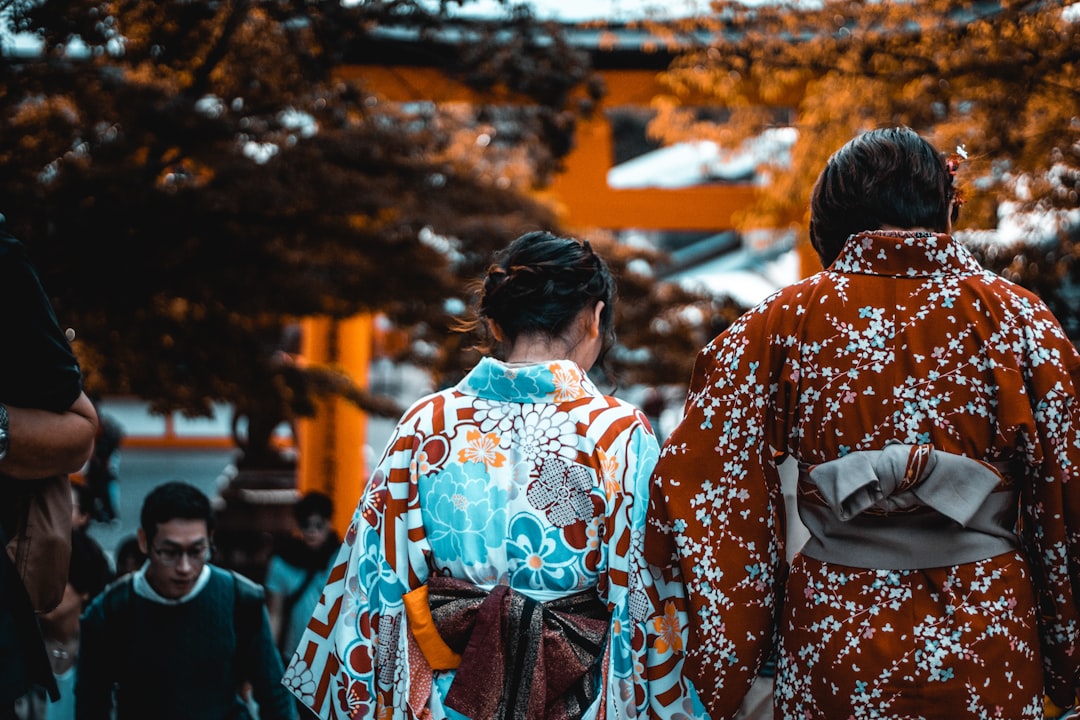
A surprisingly reliable tell is the obi — the wide sash worn around the waist. Rental shops that carry heirloom kimono often pair them with reproduction obi, because a genuine antique obi from the same period would double the cost and require a specialist to tie properly.
A real antique obi, especially one from the Meiji or early Taisho period, is stiff. It has a woven core, not a padded one. The decorative weave on the front is raised enough to feel under a finger. A reproduction obi is softer, more malleable, and easier to tie into the elaborate drum knot (the *taiko musubi*) that’s standard for a wedding. A shop owner once explained that a reproduction obi will hold its shape for about three hours before it starts to sag. A real antique obi will stay tight for a full day, because the weave is denser.
For a Shinto ceremony, which involves kneeling on a tatami mat for the sake ritual, the obi’s stability matters. A bride who’s worried about the garment shifting during the ceremony should ask about the obi’s construction. If the shop can’t say whether it’s machine-woven or hand-woven, it’s likely the former.
¥18,000 for Water Spots
Kyoto in March is cold and often damp. April is crowded. May is humid. November is the best month for a ceremony, but the kimono rental shops book slots for Shinto weddings months in advance, so availability is worse.
The heirloom pieces, being older, are more fragile. A genuine Taisho-era furisode can’t be dry-cleaned the way a modern silk garment can — the dyes run, the fabric shrinks. Shops that lend them charge a cleaning fee of ¥10,000 to ¥30,000, and they won’t accept the garment back if it’s stained by rain, sweat, or spilled sake. One couple who married at Yoshida Shrine in early April got caught in a sudden shower during the post-ceremony photographs. The bride’s furisode — one of the Yumetango pieces — was fine, but the *hakama* trousers worn by the groom had water spots that the shop charged ¥18,000 to treat.
The practical advice, passed between brides in online forums and repeated by the shop staff, is to avoid a furisode with white or pale-cream silk near the hem if the ceremony is in a month with any chance of rain. A dark-colored obi also helps — if the bride spills sake during the *san-san-kudo* ritual, a dark obi won’t show the stain.
What to Inspect Before You Commit
A checklist, compiled from conversations with shop owners, stylists, and brides who’ve done this, covers the main points to verify before paying a deposit:
– The collar. A real antique kimono has a *haneri* (the inner collar) that’s a separate piece of white silk, hand-stitched in place. A rental kimono has it sewn in by machine.
– The lining. The inner fabric of a real heirloom piece is a different material from the outer silk — usually a finer, lighter silk that’s visible at the hem and sleeve openings. If the lining is the same fabric as the outer layer, it’s a reproduction.
– The pattern. Look at a vertical line of the pattern — a flower stem, a branch. On a hand-dyed piece, the line will have slight variation in thickness. On a machine-printed piece, it will be perfectly uniform.
– The hem weight. A real antique kimono has a small weight sewn into the hemline at the back, usually a thin lead strip, to help the garment hang properly. A rental kimono almost never has this.
– The shop’s refusal to answer questions about provenance. A shop that carries real heirloom pieces will usually volunteer the age and origin of a garment without being asked. A shop that avoids the question is hiding something.
The Afternoon You Almost Gave Up
Once the kimono is chosen, the fitting done, the obi tied, and the shrine booked, the actual ceremony is straightforward. A Shinto priest leads the couple through a purification, the sake-sharing, and the offering of tamagushi branches. The whole thing takes under half an hour. The photographs take longer.
The hard part — the searching, the price negotiations, the shop visits, the language barriers — happens before that day. For anyone considering it, the advice from those who’ve done it is consistent: start looking six months out, budget thirty percent more than the first estimate, and expect that the piece you end up wearing will be the one you found on the afternoon when you’d almost given up.
📷 Photos: Cosmin Georgian (Unsplash), H Liu (Unsplash)