Four Yards of Tulle Over a Blazer
Four Yards of Tulle Over a Blazer
The veil arrived in a flat grey box from a seamstress in Manchester who specialized in restoration work and had never been asked to embroider a wedding veil over a suit before. It was three and a half yards long, which turned out to be slightly too long for the ceremony space but exactly right for the photographs afterward. The bride wore it over a double-breasted blazer in cream silk, with wide-leg trousers and low-heeled boots that had been resoled the week before because the original soles were too slick for the stone floor of the registry office.
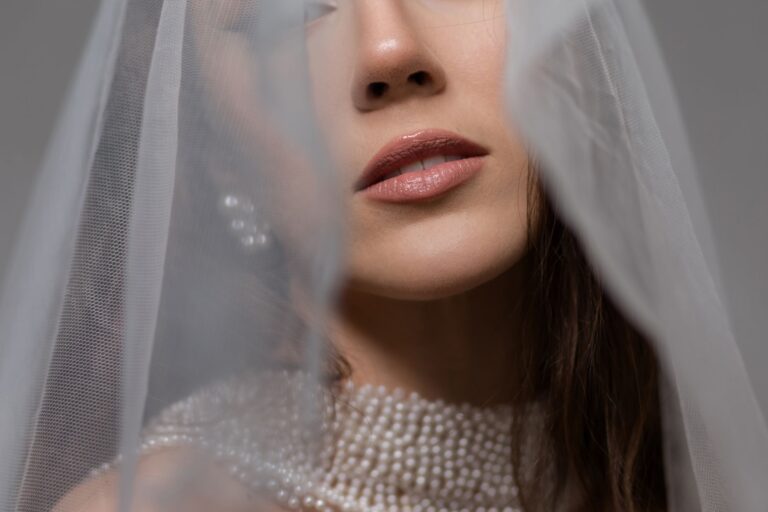
The veil itself was not white. It was a very pale champagne — the color of old paper — embroidered along one edge with small branches of olive and a single kingfisher feather in blue thread. The seamstress had charged £180 for the work, which the bride thought was low until she learned the woman had done it in the evenings over three months because she kept unpicking the feather and starting over. “It’s not the kind of thing you rush,” the seamstress had said when the bride picked it up, handing her the box as though it contained something fragile, which it did.
The Problem With “No Dress”
The decision not to wear a dress came early, about a year before the wedding, and it was not a political statement or a fashion experiment. It was simply that the bride had never felt comfortable in dresses. She had worn one to her brother’s wedding six years earlier — a navy sheath with a boatneck — and had spent the entire evening tugging at the hem and wondering if everyone could see the sweat marks under her arms. The memory was still precise enough to make her wince.
The problem was that most alternatives felt like substitutes. Jumpsuits were either too casual or too evening-gown. Two-piece sets read as bridesmaid, not bride. And suits, she discovered quickly, had their own issues. “You think a suit will be simpler than a dress,” she told a friend in the fitting room of a shop on Carnaby Street, standing in front of a three-way mirror in a white trouser set that made her look like she was about to board a yacht. “But it’s not simpler. It’s just a different set of problems.”
The suit was easier to fit than a dress — she had a long torso and short legs, which meant off-the-rack dresses either gaped at the waist or hit at an awkward point on her shin. Suits could be tailored more precisely, and a good tailor cost less than a bespoke gown. But a suit also carried expectations. White suit, cream suit, ivory suit — it didn’t matter what shade she picked, the people at the shops kept showing her the same thing: a slim-fit jacket with matching slim trousers, as though the only way to wear a suit to a wedding was to minimize its presence.
The veil was a late addition, suggested by a friend who had worn one over a pantsuit for her own wedding three years before. “It’s the one thing that makes it read as wedding, not as a really nice work outfit,” the friend had said. And that turned out to be true. Without the veil, the suit looked like something she might wear to a gallery opening or a dinner with her in-laws. With the veil, the silhouette shifted.
The Seamstress and the Feather
Finding someone to do the embroidery took longer than finding the suit. The bride went through three embroiderers before settling on the seamstress in Manchester. The first was a bridal shop that offered custom veils but only in white or ivory, and only with lace. The second was an Etsy seller who quoted £300 and a six-week turnaround but whose reviews mentioned that the thread color was never quite what was shown in the photos. The third, the one she eventually chose, was recommended by a vintage clothing restorer who had worked with her on a previous project.
They met over a video call in February, the seamstress in her workshop with two cats visible behind her on a windowsill. She asked to see the suit, asked to see a photo of the bride’s mother’s wedding dress (she was using the feather motif from a detail on the mother’s dress), and asked what kind of fabric the veil would be attached to. “Polyester tulle is fine for most things,” she said, “but for embroidery, you want silk. The polyester will pucker where the thread goes through.”
The bride ordered silk tulle from a mill in Suffolk that usually supplied theaters and opera houses — £45 for four yards, plus shipping. It arrived folded in tissue paper and was so light that when she held it up to the window, she could barely see the fabric itself, only the shadow of the fold lines.
The embroidery took twelve weeks. The seamstress sent three progress photos: one of the olive branches halfway done, one of the feather unpicked and restarted, and one of the finished edge with a note that said, “Bring it back if you change your mind about the length. I can take off four inches without losing the feather.”
Morning of
The wedding was a Thursday in September, which had seemed like a good idea at the time of booking because Thursdays were cheaper and the registry office had availability. On the morning itself, it rained — not the kind of romantic drizzle that photographs well, but a steady, indifferent London rain that soaked through shoes in five minutes and turned the pavement into a mirror of grey sky.
Getting dressed took forty minutes, which was twenty minutes longer than the bride had budgeted. The silk top under the blazer kept bunching at the collar, the trousers needed to be pinned at the ankle because the tailor had taken them up two inches but not tapered them, and the veil — the veil was the problem. She had assumed it would attach to her hair with a simple comb, but the silk tulle was too fine to hold the weight of the embroidery, and the comb slipped out twice before she switched to a small clip on each side, hidden under the fabric.
There was a moment, standing in front of the hotel room mirror with the rain streaking the window behind her, when she considered taking the veil off entirely. The suit looked fine without it. Better, maybe — cleaner. The veil added a fussiness that didn’t feel like her. But she had paid for it, traveled to Manchester for it, waited three months for it. So she kept it on, adjusted the clips one more time, and walked out into the rain with her hand over her head to keep the tulle from getting wet.
The Registry Office and the Rain
The ceremony room at the registry office was small, with high windows and a carpet that had seen too many weddings to hold a distinct pattern anymore. The registrar — a woman in her fifties with a calm voice and a small star-shaped brooch — did not comment on the veil or the suit, which the bride took as a good sign. She had worried about getting a registrar who would make a joke about the outfit, who would say something like “we don’t see many of those” in the middle of the ceremony. This registrar simply checked that the witnesses had their pens ready and began.
The veil behaved well during the ceremony, draping down the bride’s back without catching on the blazer or getting stepped on by the person standing next to her. But when she turned to walk back down the aisle, the edge of the tulle brushed against a table leg and one of the clips came loose. She caught the veil before it fell, tucked it back into her collar, and kept walking. Nobody seemed to notice.
Afterward, during the photographs outside the registry office, the rain had stopped. The photographer — a friend of a friend who shot mostly concerts and had never done a wedding — positioned the bride against a brick wall with wet ivy and told her to “look like you just got away with something.” The veil, slightly damp, hung straight instead of floating, but the embroidery showed up clearly against the wet brick. The blue of the feather was the only color in the shot that wasn’t grey or green or cream.
The Reception and the Veil That Wouldn’t Stay
The reception was at a pub around the corner — a long room with a fireplace, wooden tables, and a sound system that someone’s cousin had set up on the morning of. The bride sat with her back to the fire, and twice during dinner the heat made the edge of the veil curl upward, and twice someone at the table reached over and gently pressed it back down.
At some point during the speeches, the veil slipped off one clip entirely. The bride caught it, wrapped the fabric around her hand, and tucked the whole thing into the collar of her blazer like a scarf. She left it there for the rest of the evening. The seamstress had said in her note that it was fine to tuck it up if it got in the way — “it’s meant to be worn, not worried about” — and the bride had remembered that at exactly the right moment.
The suit survived the evening better than the veil. The blazer came off after the first dance, and the silk top underneath — short-sleeved, with a small keyhole at the back — turned out to be the right choice for a room that got progressively warmer as the night went on. One of the guests spilled red wine on the trousers near the knee, but the tailor had used a dark cream fabric that didn’t show stains well enough to worry about, and by the time the bride noticed, she had stopped caring.
Coffee Stains and a Missing Clip
A week after the wedding, the bride picked up the suit from the dry cleaner. The wine stain had come out, but a small coffee mark near the hem had not — no one had even noticed it at the wedding, but it was there now, a faint brown shadow on the cream fabric. The veil was still in its box, and when she opened it to check the embroidery, she found that one of the small clips was missing. She had no idea when it had fallen out. The seamstress would probably disapprove, but the bride has not yet called to ask.
If she had to do it again, she said later, she would choose the same outfit but handle the veil differently. Either a shorter veil, one that stopped at the shoulders and didn’t need to be managed, or no veil at all — with the embroidery moved to the blazer instead, along the lapel or the back yoke. The kingfisher feather deserved to be seen, and the veil hid it half the time anyway.
The main piece of advice was simple but came with a caveat: test the veil with the suit before the day of the wedding. Not just for how it looks, but for how it behaves. Put the clips in and take them out. Walk around the house with it on. Sit down in a chair and stand up again. Bump into a table and see if it snags. The bride had done none of these things, and the morning-of scramble was the result.
The second piece of advice was about fabric. If the veil is going to be embroidered, use silk tulle and be prepared for it to cost more than the standard version. The poly-mix veils from bridal shops are heavier and stiffer, and they resist embroidery in a way that silk doesn’t. The silk will wrinkle and crease and do all the things delicate fabrics do, but it will also hold the thread properly and hang the way it’s supposed to. The seamstress was right about that.
The third was about expectations. A veil over a suit is not a veil over a dress. It sits differently, moves differently, and reads differently in photographs. Some people will see it and think “bride.” Others will see it and think “that’s a person with a veil over a suit.” Neither reaction is wrong, but the person wearing it should know before the wedding that not everyone will understand the choice, and that this is fine — the understanding that matters is the one in the mirror.
The bride’s suit is now at the dry cleaner’s, waiting to be picked up. The veil is back in the flat grey box, folded in acid-free tissue paper, the kingfisher feather still holding its shape after one wedding and one rainy walk and one night tucked into a blazer collar. The clips are still in it, because nobody remembered to take them out.
📷 Photos: Phakphoom Srinorajan (Unsplash), Navid Abedi (Unsplash)